A passing score of 675 on the CompTIA Data+ exam looks like 75 percent, and it is not. DA0-002 is scored on a scale that runs from 100 to 900, so the bottom of the range is 100 rather than zero, and the 675 figure cannot be converted into a percentage of questions answered correctly at all. Candidates who assume otherwise end up building a study plan around a target that does not exist.
That matters more than it sounds, because it changes how you read every practice test you sit. CompTIA Data+ puts a maximum of 90 questions in front of you in 90 minutes for $264 USD, mixing multiple-choice with performance-based items across five weighted domains. This guide works through the scoring, all five domains, what the version two blueprint added, and where the credential sits against its nearest sibling.
Why Is 675 Not the Same as 75 Percent?
Because the Data+ scale starts at 100, not zero. CompTIA reports DA0-002 results on a scaled range of 100 to 900, and the pass mark is 675 on that scale. A scaled score is a statistical translation of raw performance, adjusted so that different versions of an exam demand the same standard, which means it deliberately does not correspond to a fixed number of correct answers.
The practical consequence is that no honest source can tell you how many of the 90 questions you need to get right. That number moves with the form of the exam you receive. Anyone who publishes a precise raw-question threshold for Data+ is inferring it, and inferring it from a scale whose floor is 100 usually produces a figure that is too low.
How to read a practice test result instead
Treat practice percentages as a relative signal rather than a prediction. If you are scoring consistently in the mid-eighties on domain-tagged practice questions, you have headroom. If you are hovering at the low seventies and telling yourself that clears 675, you are relying on a conversion that does not exist. The safer habit is to look at which domains are dragging the average rather than at the average itself.
It also explains why CompTIA does not publish a percentage anywhere on its own materials. The official Data+ certification page gives the scale and the cut score and stops there, which is the accurate way to state it.
Where Do the Marks Sit Across the Five Data+ Domains?
Data Analysis is the largest domain at 24 percent, followed by Data Acquisition and Preparation at 22. Data Concepts and Environments and Visualization and Reporting each carry 20 percent, and Data Governance closes the list at 14. The five weightings sum to 100, and CompTIA publishes exactly the same figures as the money-site syllabus page.
| Domain | Weight | Approximate questions of 90 |
|---|---|---|
| Data Analysis | 24% | 22 |
| Data Acquisition and Preparation | 22% | 20 |
| Data Concepts and Environments | 20% | 18 |
| Visualization and Reporting | 20% | 18 |
| Data Governance | 14% | 13 |
The interesting thing about that table is how flat it is. Four of the five domains sit between 20 and 24 percent, and even the smallest is 14. There is no cheap domain on Data+, and no domain that dominates enough to carry a pass on its own. That is a different planning problem from an exam with a 40 percent monster and a 5 percent afterthought.
Read together with the first two domains, the shape of the credential emerges. Acquisition, preparation and analysis together are 46 percent, which is the hands-on middle of an analyst’s day. Concepts and governance bookend it with 34 percent of vocabulary and rules, and reporting takes the remaining 20 for turning the answer into something a colleague can use.
What Is the CompTIA Data+ Exam Format?
DA0-002 is a maximum of 90 questions in 90 minutes at $264 USD, needing 675 on a 100 to 900 scale, delivered through Pearson VUE. The paper mixes multiple-choice questions with performance-based items, and it is offered in English and Japanese. CompTIA labels the current blueprint version two.
| Specification | Detail |
|---|---|
| Exam code | DA0-002 |
| Exam version | V2 |
| Questions | Maximum of 90, multiple-choice and performance-based |
| Duration | 90 minutes |
| Passing score | 675 on a scale of 100 to 900 |
| Price | $264 USD |
| Languages | English and Japanese |
| Delivery | Pearson VUE |
Why “maximum of 90” is worded that way
Performance-based items take longer to answer and count differently from a multiple-choice question, so the paper does not always contain a fixed 90 items. CompTIA words it as a maximum for that reason. In planning terms, assume a minute per question and expect the performance-based items to eat into that budget, which means the multiple-choice section has to move faster than one minute each.
The other timing fact worth knowing is that Data+ has no published retake waiting period on the syllabus page, and CompTIA’s own page states the credential usually retires around three years after launch, currently estimated at 2028. Working against a Data+ practice test under the real 90 minute clock is the fastest way to discover whether the performance-based items are what slow you down.
What Does Data Acquisition and Preparation Ask You to Do?
Twenty-two percent of DA0-002 sits in acquisition and preparation, and all three of its objectives are scenario-framed. You are asked to use data acquisition methods, to perform data exploration that identifies possible inconsistencies with a data set, and to perform appropriate data transformation and cleansing techniques. Every one begins “given a scenario”, which tells you the format.
That phrasing is the signal to study this domain by doing rather than reading. A scenario objective does not ask what data cleansing is; it hands you a data set with a problem in it and asks which technique applies. The examinable skill is matching a symptom to a treatment, and there is no shortcut to that other than having done it on messy data.
Exploration comes before transformation for a reason
The middle objective is the one candidates undervalue. Identifying inconsistencies is the diagnostic step: duplicates, mismatched types, out-of-range values, unexpected nulls, inconsistent encodings. Transformation is the treatment that follows. An exam question that gives you a cleansing technique and asks whether it is appropriate is really asking whether you diagnosed the problem correctly first.
Combined with the 24 percent Data Analysis domain that follows it, this is 46 percent of the paper spent on getting data into a usable state and then drawing a conclusion from it. Study those two together rather than as separate topics, because on the job and on the exam they are one continuous workflow.
Why Is Data Analysis the Heaviest Domain With the Fewest Objectives?
Data Analysis carries 24 percent of DA0-002, the largest share of any domain, across only two objectives: selecting the appropriate statistical method or function for a scenario, and troubleshooting basic issues using the appropriate tool or method, including issues that users have reported. Fewer objectives at a higher weight means each one is examined in more depth.
The first objective is the heart of the credential. It is not asking you to derive a statistic; it is asking you to choose one. Given a business question and a data set, which measure of central tendency, which test, which function actually answers it. That is a judgement question with a right answer, and it is exactly the kind of thing a scaled-score exam is good at measuring.
The second objective is quietly unusual. Most analytics syllabuses stop at producing the analysis; Data+ examines what happens when the analysis is wrong and somebody says so. User-reported issues are named explicitly, which puts the credential closer to a working analyst’s week than to a statistics course.
The planning implication is direct: you cannot cover this domain by breadth because there is no breadth to cover. Twenty-two questions across two objectives means depth, and the only way to build it is repeated practice on scenario-style questions until method selection is fast.
What Changed Now That AI Concepts Are on the Blueprint?
The version two blueprint puts artificial intelligence inside the Data Concepts and Environments domain as an explicit objective. CompTIA states it covers identifying AI models, natural language processing and robotic automation. It is a recognition objective rather than a build objective: you are expected to know what these things are and where they sit, not to train anything.
Placing it in the concepts domain rather than in analysis is the tell. AI here is treated as part of the environment an analyst now works inside, alongside database types, file formats and infrastructure, rather than as a technique the analyst applies. That is a defensible call for an entry-to-mid credential and it keeps the objective answerable.
Practically, the study effort is small and the return is reliable. Learn to distinguish the model families at a descriptive level, know what natural language processing does to unstructured text, and understand robotic automation as rule-driven task execution rather than intelligence. That is enough for a recognition objective inside a 20 percent domain.
The same domain is also where the genuinely obscure vocabulary lives. The objectives name fact tables, dimensional tables, bridge tables and the slowly changing dimension by name, and that last one catches out candidates who have used a warehouse without ever having to name what they were using.
How Much Ground Does 14 Percent of Data Governance Cover?
More than the weighting suggests. Data Governance is the smallest domain on DA0-002 at 14 percent, but it carries four objectives: explaining data management concepts, summarising data compliance concepts, comparing data privacy and protection practices, and comparing data quality assurance practices. That is roughly thirteen questions spread across four genuinely separate subjects.
The objectives are also phrased differently from the rest of the blueprint. Where the middle domains say “given a scenario”, governance says “explain”, “summarize” and “compare and contrast”. Those are knowledge verbs, which means this domain rewards reading in a way the scenario domains do not, and it is the one place on Data+ where flashcards genuinely work.
Documentation, versioning and lineage
CompTIA names documentation, versioning and data lineage within the data management objective. Lineage is the one worth a deliberate half hour: knowing where a figure came from, through which transformations, is the governance answer to the troubleshooting objective in the Data Analysis domain, and the two connect more than the blueprint layout suggests.
For the compliance and privacy objectives, the useful framing is the difference between privacy as a policy question about what you are allowed to do with data, and protection as a technical question about keeping it safe. Candidates who want more structure than the objectives give can map them against the DAMA data management framework, which organises the same territory in far more depth.
How Should You Prepare for a Performance-Based Paper?
Preparation for DA0-002 has to reflect a flat blueprint and a mixed item format. There is no dominant domain to lean on and no cheap domain to skip, so the order below follows dependency rather than weight, and it is deliberately sequential because each stage supplies what the next one assumes.
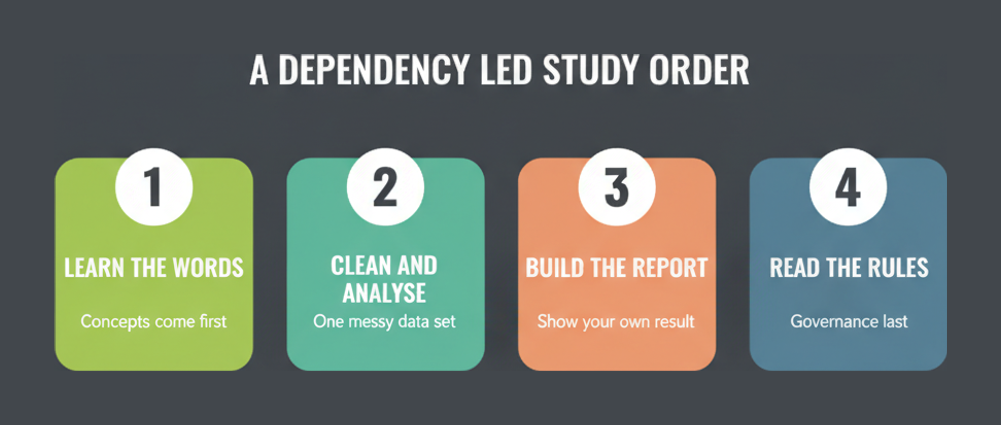
- Start with Data Concepts and Environments, because the vocabulary it defines, from table types and schemas to file formats and data structures, is the language every later domain phrases its questions in.
- Work acquisition, preparation and analysis together as one continuous exercise on a real messy data set, since 46 percent of the paper sits across those two domains and they describe a single workflow rather than two topics.
- Move to Visualization and Reporting once you have a result worth presenting, practising the delivery and consumption choices and the report validation techniques on output you produced yourself.
- Finish with Data Governance as a reading block, because it is the one domain phrased in knowledge verbs rather than scenarios, and it is where flashcards on compliance, privacy, protection and quality assurance genuinely pay.
Layer performance-based practice across all four stages rather than saving it. The performance-based items are the reason the question count is stated as a maximum, and they are the part of the paper that punishes a purely theoretical preparation. If you have only ever answered multiple-choice questions about data cleansing, the first item that asks you to actually do it will cost you time you have not budgeted.
A realistic schedule for someone already working with data is six to eight weeks of evenings. For a career changer it is longer, and the honest readiness signal is consistency across all five domains rather than a strong average, because a flat blueprint means a weak domain cannot be carried by a strong one.
Where Does Data+ Sit Against DataSys+ and the Analyst Roles?
Data+ and DataSys+ answer different questions about data. Data+ is about analysing it: acquiring, cleaning, interpreting and reporting. DataSys+ is about running the systems that store it: administration, security, backup and recovery. They sit side by side in CompTIA’s data portfolio rather than one above the other, and choosing between them is a question about your job rather than your level.
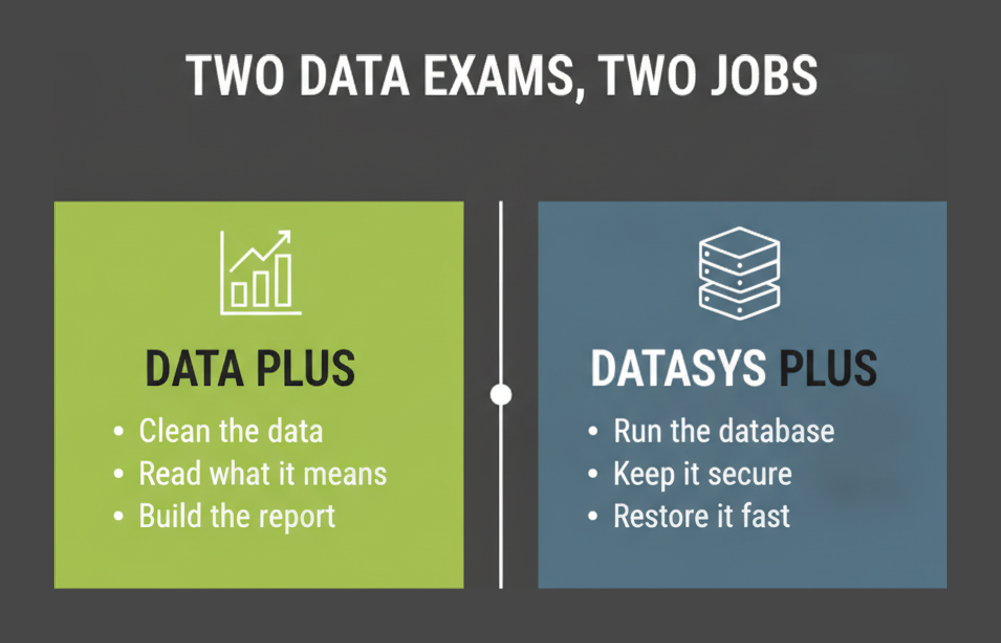
The roles Data+ maps to are data analyst, business analyst, reporting analyst, business intelligence analyst and the analytics side of operations roles. In each case the person is being handed data and asked what it means. If instead you are being handed a database and asked to keep it available, that is the other credential.
CompTIA’s full portfolio makes the split clearer than any summary, and the current lineup is set out in its certification catalogue. A detailed walkthrough of the systems-side alternative sits in this guide to the DataSys+ credential, which covers the objectives Data+ deliberately leaves out.
If you have already decided on Data+ and want the exam materials rather than the comparison, the site’s DA0-002 resource page collects them in one place.
Frequently Asked Questions
What is the passing score for CompTIA Data+?
675 on a scale of 100 to 900. Because the scale starts at 100 rather than zero, that figure is not 75 percent and cannot be converted into a number of correct answers.
How many questions are on the DA0-002 exam?
A maximum of 90, mixing multiple-choice with performance-based items, in 90 minutes. CompTIA words it as a maximum because performance-based items do not count the same way.
How much does the CompTIA Data+ exam cost?
Two hundred and sixty-four US dollars, booked through Pearson VUE. CompTIA does not publish the price on its certification page, so that figure comes from the money-site syllabus page.
Which Data+ domain is the largest?
Data Analysis at 24 percent, roughly 22 questions. It has only two objectives, so it is examined in depth rather than breadth, mainly on statistical method selection.
Does CompTIA Data+ cover artificial intelligence?
Yes. The version two blueprint puts an AI objective inside Data Concepts and Environments, covering identifying AI models, natural language processing and robotic automation at a recognition level.
What is the difference between Data+ and DataSys+?
Data+ is about analysing data: acquisition, cleansing, analysis and reporting. DataSys+ is about running the systems that hold it, including administration, security, backup and recovery.
When does DA0-002 retire?
CompTIA states its exams usually retire around three years after launch and gives an estimated retirement of 2028 for this version. That is an estimate rather than a published end date.
What languages is CompTIA Data+ offered in?
English and Japanese, according to CompTIA’s own certification page. The money-site syllabus page does not list languages, so this detail comes from the vendor.
Are there prerequisites for CompTIA Data+?
None are published on the syllabus page. The credential is aimed at people already working with data rather than complete beginners, but nothing formally blocks registration.
How long should you study for the Data+ exam?
Six to eight weeks of evenings is realistic for someone already handling data, and longer for a career changer. The blueprint is flat, so consistency across all five domains matters more than a strong average.
Conclusion
CompTIA Data+ is an unusually evenly weighted exam, and that is the fact that should shape your preparation. Four of the five domains sit between 20 and 24 percent, the smallest is still 14, and no single area can carry a pass. A maximum of 90 questions in 90 minutes, $264, English or Japanese, and a scaled cut score of 675.
Take the scoring seriously: 675 on a 100 to 900 scale is not a percentage, so read practice results by domain rather than by average. Learn the concepts vocabulary first because everything else is phrased in it, run acquisition and analysis as one workflow on genuinely messy data, practise the performance-based items rather than only reading about them, and treat governance as the reading block it is.