The CompTIA Server+ exam objectives split SK0-005 into four domains, and the split is not the one most candidates expect. Server Hardware Installation and Management, the domain the certification’s name points at, is the smallest at 18 percent. Server Administration takes 30 percent, Troubleshooting takes 28 percent, and Security and Disaster Recovery takes 24 percent. Hardware is the part you will spend the least time on.
That matters because it changes what preparation should look like. Someone who racks equipment for a living can walk into this exam confident and lose it on scripting basics, licensing concepts and server decommissioning. This article works through all four domains and the 25 objectives underneath them, what the exam costs, what the format actually is, and who CompTIA says the credential is built for.
What Do the CompTIA Server+ Exam Objectives Cover?
The SK0-005 objectives are organised into four domains: Server Hardware Installation and Management at 18 percent, Server Administration at 30 percent, Security and Disaster Recovery at 24 percent, and Troubleshooting at 28 percent. Between them they hold 25 individual objectives, ranging from racking physical equipment to explaining licensing models and troubleshooting storage.
| Domain | Weight | Objectives |
|---|---|---|
| Server Hardware Installation and Management | 18% | 3 |
| Server Administration | 30% | 8 |
| Security and Disaster Recovery | 24% | 8 |
| Troubleshooting | 28% | 6 |
The shape of that table is the single most useful thing to take from the objectives. Three quarters of the exam sits outside the hardware domain, and the two largest areas, administration and troubleshooting, are about operating a server estate rather than assembling one. Anyone budgeting study time from the certification’s name will get the allocation wrong. Infrastructure staff who move into coordination roles can read the Project+ domains and cost next.
How the objectives are phrased
The verbs matter. Objectives that open with “Given a scenario” expect applied judgement and are the ones most likely to appear as performance-based items. Objectives that open with “Explain” or “Summarize” are testing whether you can describe a concept accurately. Twelve of the 25 use the scenario phrasing, and every one of the six troubleshooting objectives is scenario-based except the theory objective. Reading the full SK0-005 syllabus with that distinction in mind tells you where recall is enough and where it is not.
Why Is Hardware the Smallest Domain on a Server Exam?
Server Hardware Installation and Management carries 18 percent and contains only three objectives: installing physical hardware, deploying and managing storage, and performing server hardware maintenance. It is the smallest domain because physical installation is the smallest part of a modern server administrator’s week, and CompTIA weights the exam toward the work rather than the name.
The three objectives are wide even so. Physical installation covers rack unit sizes, rack layout and balancing, floor load limits, cooling management, power distribution units, uninterruptible power supplies, separate circuits and separate providers, KVM placement, rail kits and cable management. Storage covers RAID levels and types, JBOD, hardware against software RAID, capacity planning, drive media types and their wear characteristics, and interface types including SAS, SATA and PCI.
The storage objective is the one that costs marks
RAID is where candidates who have only used managed infrastructure tend to come unstuck. The objectives name levels 0, 1, 5, 6 and 10 explicitly, and expect you to reason about which fits a given capacity, redundancy and performance requirement rather than to recite definitions. The differences between the standard RAID levels are worth being genuinely fluent in, because they resurface in the troubleshooting domain as well.
Drive selection is the other half. The objectives distinguish read-intensive from write-intensive solid state drives, and list spinning disk speeds of 15,000, 10,000 and 7,200 RPM alongside hybrid options. Those are the details a scenario question builds on when it asks you to specify storage for a workload.
What Does the Server Administration Domain Expect?
Server Administration is the largest domain at 30 percent, with eight objectives. It runs from installing server operating systems and configuring network infrastructure services through high availability, virtualization, scripting basics, asset management and documentation, and licensing concepts. It is the broadest domain on the exam and the one most likely to contain something outside your daily work.
The eight objectives
- Installing server operating systems, given a scenario.
- Configuring servers to use network infrastructure services, given a scenario.
- Configuring and maintaining server functions and features, given a scenario.
- Explaining the key concepts of high availability for servers.
- Summarizing the purpose and operation of virtualization.
- Summarizing scripting basics for server administration.
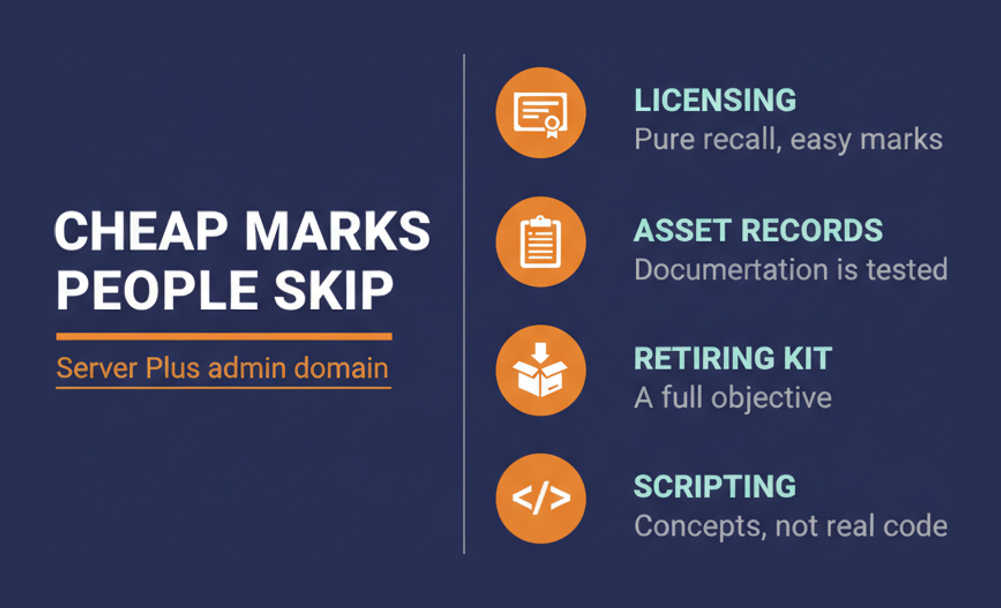
- Explaining the importance of asset management and documentation.
- Explaining licensing concepts.
Notice that only the first three are scenario-based. The remaining five ask you to explain or summarize, which means the exam is testing conceptual accuracy rather than hands-on execution. That is good news for a candidate who has never written a production script, and it is the reason the scripting objective frightens people more than it should.
Licensing and documentation are quiet mark-losers
Licensing concepts and asset management are the two objectives experienced administrators skip, on the reasonable grounds that somebody else handles them. The exam does not care. Both are full objectives inside the largest domain, and both are pure recall, which makes them among the cheapest marks on the paper to secure. Ignoring them to spend more time on hardware you already know is a poor trade.
How Much of Server+ Is Security and Disaster Recovery?
Security and Disaster Recovery carries 24 percent across eight objectives, covering data security concepts, physical security, identity and access management, data security risks and mitigation, server hardening, decommissioning, backups and restores, and disaster recovery. Nearly a quarter of the exam is about protecting and recovering a server estate rather than running it.
The domain is unusually balanced between the abstract and the procedural. Hardening methods and decommissioning are concrete sequences with a defensible right answer. Data security concepts and risk mitigation are conceptual. Backups and disaster recovery sit between the two, because the exam expects you to know both the mechanisms and why an untested backup is not a backup.
Decommissioning is easy to overlook and easy to score
Proper server decommissioning is a full objective, and it is the sort of thing that never appears in day-to-day work until the day it does. Media sanitisation, asset removal, documentation and the order those happen in are learnable in an afternoon and appear reliably. Treat it as free marks rather than an afterthought.
Disaster recovery is where the wider industry context helps
The disaster recovery objective asks about site types, replication and testing, which is exactly the territory that data centre resilience research covers in depth. The published Uptime Institute research reports are a useful way to see why the exam cares about failover testing and recovery objectives, because they document what actually causes outages in real facilities rather than in a textbook.
Why Does Troubleshooting Carry Twenty-Eight Percent?
Troubleshooting is the second-largest domain at 28 percent, with six objectives: troubleshooting theory and methodology, then common hardware failures, storage problems, operating system and software problems, network connectivity issues, and security problems. Five of the six are scenario-based, which makes this the most applied domain on the exam.
The weighting reflects what the job is. A server administrator spends far more time working out why something broke than installing something new, and CompTIA has built the exam around that reality. It also means this domain draws on every other domain: a storage troubleshooting question assumes you understood RAID from the hardware domain, and a security troubleshooting question assumes you understood hardening.
The methodology objective is the one to learn first
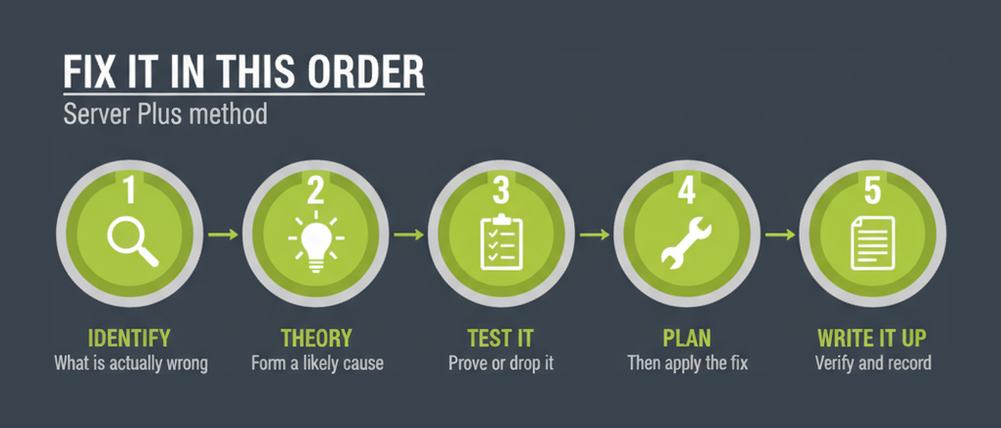
Troubleshooting theory and methodology is the only non-scenario objective in the domain, and it underpins the other five. CompTIA expects a structured approach, and the syllabus lists eight steps: identify the problem and determine its scope, establish a theory of probable cause, test the theory, establish a plan of action, implement the solution or escalate, verify full system functionality, perform a root cause analysis, and document findings, actions and outcomes throughout. Scenario questions frequently ask what you should do next rather than what is wrong, and the answer follows the methodology rather than your instinct.
Because troubleshooting draws on everything else, it is also the worst domain to leave until last. Working the four domains in isolation and then discovering that 28 percent of the paper requires all of them together is a common and avoidable mistake, and it is a recurring theme in this Server+ preparation walkthrough.
What Does Server+ Cost, and What Is the Format?
CompTIA Server+ costs $399 USD, runs for 90 minutes, and contains a maximum of 90 questions in a mix of multiple choice and performance-based formats. The passing score is 750 on a scale of 100 to 900. The current exam is version V5 under the series code SK0-005, and it can be taken at a Pearson VUE test centre or online.
| Item | Detail |
|---|---|
| Exam code | SK0-005 (version V5) |
| Questions | Maximum of 90, multiple choice and performance-based |
| Duration | 90 minutes |
| Passing score | 750 on a 100 to 900 scale |
| Price | $399 USD |
| Delivery | Pearson VUE test centre or online |
| Languages | English and Japanese |
Performance-based questions change the timing
A maximum of 90 questions in 90 minutes reads like a minute each, but performance-based items take considerably longer than a multiple choice question. They typically appear early. The practical consequence is that a candidate who works through them at a leisurely pace can find the multiple choice section compressed at the end, so the sensible approach is to flag anything slow and return to it.
The scaled score is worth understanding too. A 750 on a 100 to 900 scale is not 83 percent of the questions right, because scaling accounts for question difficulty. There is no published mapping from raw marks to scaled score, so the only safe target is consistent competence across all four domains.
Who Is CompTIA Server+ Actually For?
CompTIA recommends A+ certification or equivalent knowledge plus two years of hands-on experience in a server environment. The certification maps to the NICE and DCWF work roles of network operations specialist and systems administrator. It is aimed at someone already working with servers who wants the breadth of their knowledge formally validated, rather than at a newcomer.
That recommended experience is worth taking seriously, because of where the marks sit. The domains that dominate, administration and troubleshooting, are the ones that only make sense to someone who has run and fixed real systems. A candidate without that grounding can memorise the hardware domain and still fail, because 58 percent of the exam is asking about situations they have not been in.
Where it sits against the rest of the CompTIA path
Server+ was a good-for-life credential until 1 October 2025. CompTIA now states that a Server+ certification earned on or after that date is valid for three years and is renewed through its Continuing Education programme or by passing the latest version of the exam, which puts it on the same footing as the rest of the portfolio. It also sits alongside rather than inside the main infrastructure ladder, so it complements the A+ credential and the networking track instead of replacing a step in either. For someone whose work is specifically server operations in a data centre or hybrid environment, that specialism is the point.
The two-language constraint
The exam is offered in English and Japanese only. For a global credential that is a genuine limitation, and it is the kind of detail worth checking before building a study plan around it.
How Should You Work Through the Four Domains?
Start with Server Administration, because it is the largest domain at 30 percent and the broadest, then take Troubleshooting second so you have time to connect it back to everything else. Leave hardware until later, since it is only 18 percent and is usually the most familiar territory. Treat licensing, documentation and decommissioning as quick recall wins rather than optional extras.
- Work Server Administration first, spending most of the time on the five explain-and-summarize objectives, since those are pure recall and cover the material least likely to appear in your daily work.
- Move to Security and Disaster Recovery, learning hardening and decommissioning as ordered procedures rather than as concepts.
- Take Troubleshooting next, starting with the methodology objective, because the other five scenario objectives all assume it.
- Cover the hardware domain after that, concentrating on RAID levels and drive characteristics rather than on racking, which is the part most candidates already know.
- Finish with timed mixed practice, flagging performance-based items and returning to them, so the 90 minute limit does not surprise you on the day.
The reason for that ordering is that troubleshooting draws on the other three domains, so studying it early wastes the connections. Doing it third, once administration and security are fresh, means the scenario questions have something to attach to.
Timed practice under real conditions is the step that most changes outcomes, and the reasoning behind that is set out in this look at practice testing. The scaled scoring means you cannot know how close you are from raw marks alone, so consistency across all four domains is the only reliable signal.
Frequently Asked Questions
How many questions are on the CompTIA Server+ SK0-005 exam?
A maximum of 90 questions, in a mix of multiple choice and performance-based formats, with 90 minutes to complete them.
What are the four CompTIA Server+ domains and their weightings?
Server Hardware Installation and Management at 18 percent, Server Administration at 30 percent, Security and Disaster Recovery at 24 percent, and Troubleshooting at 28 percent.
What is the passing score for SK0-005?
750 on a scale of 100 to 900. Because the score is scaled for question difficulty, it does not correspond to a fixed percentage of questions answered correctly.
How much does CompTIA Server+ cost?
$399 USD for the exam voucher.
Do you need A+ before taking Server+?
It is not a formal requirement. CompTIA recommends A+ certification or equivalent knowledge, together with two years of hands-on experience in a server environment.
Is CompTIA Server+ a hardware exam?
No, and this is the most common misconception about it. Hardware installation and management is the smallest domain at 18 percent. Administration and troubleshooting together account for 58 percent.
Does CompTIA Server+ expire?
Yes, for anyone certifying now. CompTIA moved Server+ into its Continuing Education programme on 1 October 2025, so a certification earned on or after that date is valid for three years and is renewed through continuing education or by passing the latest version of the exam.
What languages is SK0-005 available in?
English and Japanese.
Can you take Server+ online?
Yes. It is available both at Pearson VUE test centres and through online testing.
What jobs does CompTIA Server+ map to?
CompTIA maps it to the NICE and DCWF work roles of network operations specialist and systems administrator.
Conclusion
The CompTIA Server+ exam objectives reward candidates who read the weightings before building a study plan. Hardware is 18 percent, the smallest of the four domains, while Server Administration takes 30 percent and Troubleshooting 28. If the certification’s name shapes your preparation, you will spend most of your effort on the least of the exam.
Work administration first for its breadth, treat troubleshooting as the domain that draws on everything else, and pick up licensing, documentation and decommissioning as the cheap recall marks they are. With a maximum of 90 questions in 90 minutes and a scaled pass mark of 750, there is no single domain you can afford to write off, and no way to tell from raw marks how close you are. Even coverage, checked under timed conditions, is what gets it done.