Divide 720 by 900 and you get 80 percent, a figure that study groups repeat constantly and that CompTIA has never attached to N10-009. The CompTIA Network+ exam, series code N10-009, is scored on a scale that starts at 100 rather than zero, so the 720 pass mark is a position on a scaled range and not a share of questions answered correctly. That one misunderstanding shapes how people prepare, because it makes the exam sound more forgiving than its five domains actually are.
This article sets out the N10-009 objectives as the syllabus publishes them: five domains weighted 23, 20, 19, 14 and 24 percent, thirty numbered objectives beneath them, up to 90 questions in 90 minutes, and a mix of multiple-choice and performance-based items. It then explains what the scoring model does and does not tell you, how the two kinds of performance-based question behave differently on the day, what moved when N10-008 was retired, which standards the objectives name, and in which order the domains are worth studying. Everything here is taken from the published syllabus and from CompTIA’s own policy pages.
How Is the N10-009 Exam Scored?
N10-009 is scored on a scale of 100 to 900, and the passing score is 720. The paper holds a maximum of 90 questions, mixing multiple-choice and performance-based items, and runs for 90 minutes. The scaled figure is not a percentage of correct answers, and neither CompTIA nor the published syllabus states how many questions you need right to reach 720.
The practical consequences are worth spelling out. First, a scaled score means two candidates can answer a different number of items correctly and still land on the same number, because the scale accounts for the difficulty of the form each one sat. Second, since no percentage equivalent is published, any target like “aim for 80 percent on practice tests” is a rule of thumb rather than a fact about the exam. Treat practice scores as a trend, not a prediction.
Third, the performance-based items can earn partial credit. CompTIA’s exam-development guidance says that partial credit may be given on both simulation and virtual-environment questions, so an incomplete answer is worth more than a blank one. That changes the calculus on the day: a half-finished configuration task should be submitted rather than abandoned.
The official Network+ page lists the same core facts the syllabus page carries, and it adds that the paper is version V9, launched on June 20, 2024, and is delivered in English, German, Japanese, Portuguese and Spanish. The syllabus lists the fee at $399 and the delivery channel as Pearson VUE.
| Exam fact | N10-009 |
|---|---|
| Questions | Up to 90, multiple-choice and performance-based |
| Duration | 90 minutes |
| Passing score | 720 on a scale of 100 to 900 |
| Fee | $399 USD |
| Delivery | Pearson VUE |
| Languages | English, German, Japanese, Portuguese, Spanish |
| Version | V9, launched June 20, 2024 |
What Are the N10-009 Objectives and How Much Is Each Domain Worth?
The N10-009 objectives are grouped into five domains: Networking Concepts at 23 percent, Network Implementation at 20, Network Operations at 19, Network Security at 14 and Network Troubleshooting at 24. Thirty numbered objectives sit beneath those headings, eight of them in Networking Concepts alone, and the two largest domains together account for almost half of the scored content.
| Domain | Weight | Objectives | What it really covers |
|---|---|---|---|
| Networking Concepts | 23% | 8 | OSI layers, appliances, cloud connectivity, ports and protocols, media and transceivers, topologies, IPv4 addressing, modern use cases such as SDN, VXLAN, zero trust and IaC |
| Network Implementation | 20% | 4 | Routing technologies, switching features, wireless configuration, physical installation factors |
| Network Operations | 19% | 5 | Documentation and change processes, monitoring, disaster recovery, IPv4 and IPv6 services, access and management methods |
| Network Security | 14% | 3 | Security concepts, attack types, defence techniques and solutions |
| Network Troubleshooting | 24% | 5 | The methodology, cabling and interface faults, service faults, performance faults, tools and commands |
Weight and objective count do not line up, and that matters for planning. Networking Concepts has the most objectives and the second-highest weight, so each objective there is worth comparatively little. Network Security has only three objectives for 14 percent, so each of those three is dense: the first one alone runs from encryption and PKI through IAM, RADIUS, SAML and TACACS+ to physical security, honeypots, PCI DSS and segmentation of IoT and SCADA networks.
Networking Concepts also hides the newest material. Its eighth objective, summarising evolving use cases for modern network environments, is where SDN and SD-WAN, VXLAN, zero trust architecture, SASE and SSE, infrastructure as code and IPv6 transition all live. Candidates working from older notes tend to skim this objective because it reads like a glossary, and it is the part of the domain their notes do not cover.
The full N10-009 objective list on EduSum prints every sub-topic under each objective, down to the individual port numbers and show commands, and is the reference this article was built from. Read it once with the weights beside you before you open any study guide.
Why Does Network Troubleshooting Carry the Largest Weight?
Network Troubleshooting is 24 percent of N10-009 because it is the domain where every other domain gets applied. Its five objectives cover a fixed methodology, cabling and physical interface faults, network service faults, performance faults, and the tools and commands used to find them. A troubleshooting item can draw on addressing, switching, wireless and security knowledge in a single scenario.
The methodology is a fixed sequence
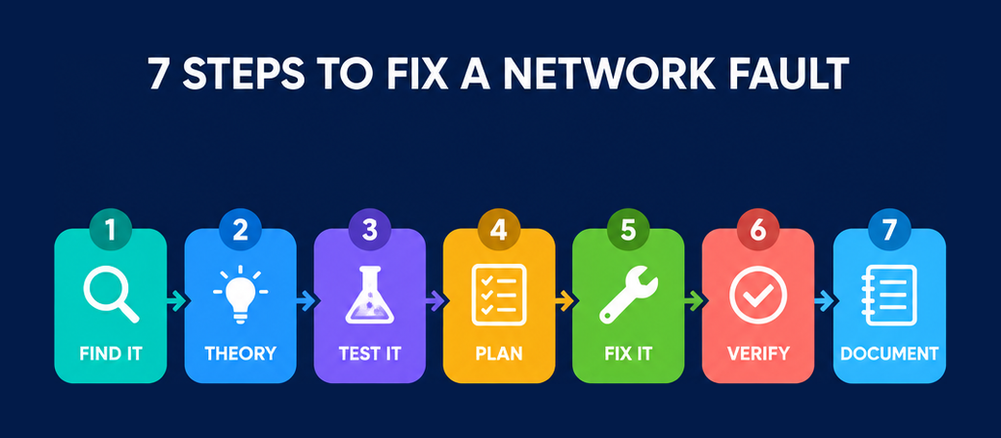
The first objective in the domain asks you to explain the troubleshooting methodology, and the syllabus lists it as an ordered set of steps: identify the problem, establish a theory of probable cause, test the theory to determine the cause, establish a plan of action and identify potential effects, implement the solution or escalate, verify full system functionality and implement preventive measures, and document findings, actions, outcomes and lessons learned. Questions on this objective usually describe a situation and ask which step comes next, so the order has to be known cold.
Inside those steps the syllabus names specific techniques: questioning users, determining whether anything has changed, duplicating the problem, approaching multiple problems individually, and working top-to-bottom or bottom-to-top through the OSI model or by divide and conquer. These are the phrases the answer options will use.
The faults are specific, not generic
The remaining objectives are lists of concrete faults. Cabling covers incorrect cable choice, crosstalk, interference, attenuation, improper termination, transposed transmit and receive pairs, rising CRC, runt, giant and drop counters, error-disabled and administratively down ports, PoE budget problems and transceiver mismatches. Services covers spanning tree loops and root bridge selection, wrong VLAN assignment, ACLs, routing table and default route problems, address pool exhaustion, wrong gateway, duplicate addresses and wrong subnet masks. Performance covers congestion, bottlenecks, latency, packet loss, jitter and a full set of wireless faults from channel overlap to roaming misconfiguration.
The tools objective is the one most candidates underestimate. Beyond ping, traceroute, nslookup, dig, netstat, tcpdump, arp and Nmap, it names LLDP and CDP, a protocol analyser, cable testers, taps, a Wi-Fi analyser and a visual fault locator, and then seven device commands: show mac-address-table, show route, show interface, show config, show arp, show vlan and show power. Expect to be shown output from one of those and asked what it means.
What Do the Performance-Based Questions Look Like?
N10-009 performance-based questions, or PBQs, are items that ask you to do something rather than pick an answer. CompTIA delivers them either as simulations, which approximate a tool such as a firewall, a network diagram, a terminal window or an operating system, or as virtual environments, which are real virtual machines running actual software. Both types can earn partial credit.
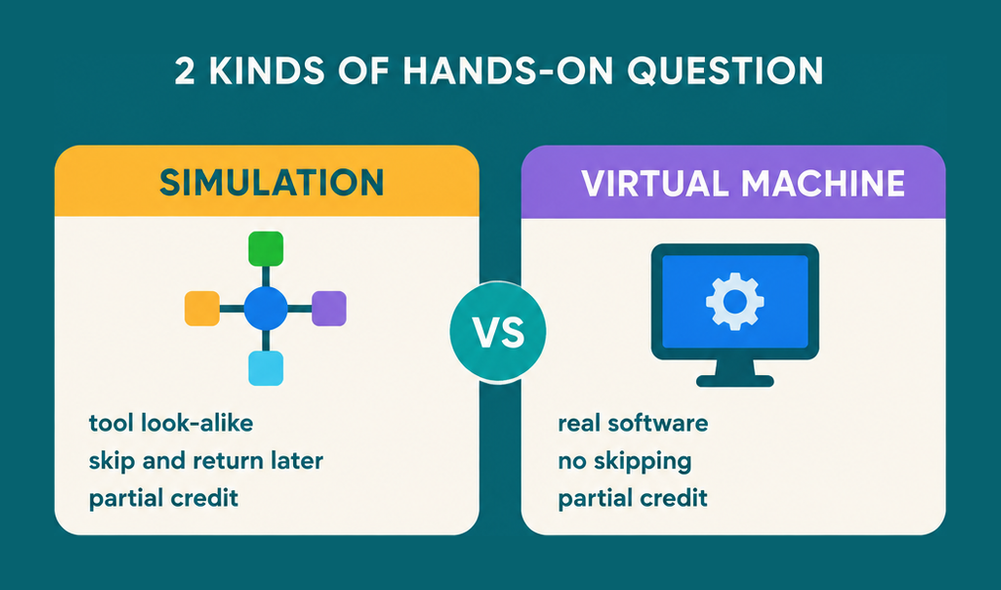
The two types behave differently once you are in the exam, and the difference is worth knowing before you sit down. According to CompTIA’s exam-development guidance, a simulation PBQ can be skipped and returned to later, while a virtual-environment PBQ cannot: it has to be completed when you reach it. The PBQ guidance from CompTIA also notes that simulations have restricted functionality by design, while a virtual environment will let you take every wrong path a real system would.
What a Network+ simulation tends to ask
CompTIA does not publish which objectives get PBQ treatment, so the honest guide is the objectives themselves. The ones phrased “given a scenario” are the natural candidates: using appropriate IPv4 addressing, configuring switching technologies and features, selecting and configuring wireless devices, implementing IPv4 and IPv6 network services, and the four scenario objectives in Network Troubleshooting. A network diagram with a fault to locate, a terminal window with addresses to assign, or a switch interface to configure for the right VLAN all fit the simulation definition exactly.
How many PBQs are there?
CompTIA does not state a count for any exam. Its own guidance says only that the number of PBQs is expected to increase over time as exams are refreshed. Plan for several, place them early in your time budget, and remember the partial credit rule: a simulation you cannot finish should still be submitted with whatever you completed.
A sensible pacing rule follows from the format. With up to 90 items in 90 minutes, a multiple-choice question is worth well under a minute of thought, and the minutes saved there are what pay for the PBQs. The sample questions published alongside the syllabus are scenario-style multiple-choice items, including several that ask for two answers, which is a useful rehearsal for reading a scenario quickly before the PBQs demand more.
N10-008 to N10-009: What Moved
N10-009 replaced N10-008 as the live Network+ exam on June 20, 2024, and the English N10-008 exam retired in December 2024. Four of the five domain weights changed. Network Troubleshooting rose from 22 to 24 percent, Network Operations from 16 to 19, Network Implementation fell from 24 to 20, Networking Concepts fell from 24 to 23, and Network Security stayed at 14.
| Domain | N10-008 | N10-009 | Change |
|---|---|---|---|
| Networking Fundamentals / Networking Concepts | 24% | 23% | down 1 |
| Network Implementation | 24% | 20% | down 4 |
| Network Operations | 16% | 19% | up 3 |
| Network Security | 14% | 14% | no change |
| Network Troubleshooting | 22% | 24% | up 2 |
The content shift is larger than the weights suggest. CompTIA added software-defined networking and SD-WAN, infrastructure as code, VXLAN for large-scale deployments, intermediate and main distribution frames, zero trust architecture and the SASE and SSE frameworks, and extended its coverage of modern network environments and physical installations. Most of that landed in the eighth Networking Concepts objective and the physical installation objective in Network Implementation.
“Network+ equips employees with the foundational network security skills crucial for identifying vulnerabilities, managing network access, and implementing network security controls.”
For anyone holding N10-008 study material, the arithmetic is simple. The routing, switching, wireless, addressing and troubleshooting chapters still map to live objectives. The gaps are the modern-environment topics listed above, which an N10-008 book either omits or mentions in passing, and the reweighting means the operations and troubleshooting chapters now deserve more time than the implementation chapter. Search demand for N10-008 practice material is still high, which is exactly why the version has to be checked before anything is bought.
Which Standards and Protocols Does the Syllabus Name?
The N10-009 objectives name their standards explicitly rather than describing them. IPv4 addressing cites RFC 1918 private ranges and APIPA; transmission media cites the 802.11 wireless and 802.3 wired families; switching cites 802.1Q tagging; wireless cites 802.11h for regulatory impacts; and network access control cites 802.1X alongside port security and MAC filtering. The ports objective lists twenty protocols with their numbers.
Those named standards are the parts of the exam you can study from the source. The private address ranges in RFC 1918 from the IETF are three blocks, 10.0.0.0/8, 172.16.0.0/12 and 192.168.0.0/16, and the exam expects you to recognise any address inside them, to know that they need NAT or PAT to reach the internet, and to tell them apart from an APIPA address in 169.254.0.0/16 that signals a DHCP failure.
802.1X is the port-based access control standard that underpins the “PSK vs. Enterprise” choice in the wireless objective and the NAC entry in Network Security. The current edition is IEEE 802.1X-2020, which defines how a switch port or access point authenticates a device before it is allowed onto the LAN; on the exam it appears next to RADIUS, which is the authentication server the standard is most often paired with.
The ports list
The ports and protocols objective is the most memorisation-heavy item in the exam, and the syllabus prints the exact pairings: FTP 20/21, SSH and SFTP 22, Telnet 23, SMTP 25, DNS 53, DHCP 67/68, TFTP 69, HTTP 80, NTP 123, SNMP 161/162, LDAP 389, HTTPS 443, SMB 445, Syslog 514, SMTPS 587, LDAPS 636, SQL Server 1433, RDP 3389 and SIP 5060/5061. The same objective lists the IP types ICMP, TCP, UDP, GRE and IPsec with its AH, ESP and IKE components, and the four traffic types unicast, multicast, anycast and broadcast. There is no shortcut here; the list is the content.
How Long Is N10-009 Valid and What Are the Retake Rules?
A Network+ certification is valid for three years from the certification date and is renewed through CompTIA’s continuing education programme. If you fail, CompTIA imposes no waiting period before a second attempt, requires at least 14 calendar days before a third or any later attempt, and charges the full exam fee every time. The N10-009 paper itself is expected to retire around 2027.
Renewal has four routes. You can complete a CompTIA CertMaster CE course, which completes the CEU requirement automatically and carries no additional CE fee; pass the latest version of the Network+ exam; earn a higher-level CompTIA certification; or submit continuing education units from approved activities such as training, coursework, work experience or community involvement. The CEU and fee details are set out on the CompTIA continuing education page, which is where the current CE fee and CEU count for Network+ should be checked rather than taken from a third-party summary.
The retake policy is easy to misread in the other direction. The certification retake policy states plainly that there are no free retests and no retake discounts, so a second attempt is another $399 unless a voucher bundle with retake assurance was bought in the first place. The absence of a wait between the first and second attempt is useful only if you know why you failed; the score report lists the objectives you missed, and that is the document to study before rebooking.
CompTIA’s recommended background is an A+ certification plus 9 to 12 months of hands-on work in a junior network administrator or network support technician role, and it maps the credential to the technical support specialist, network operations specialist and system administrator work roles in the NICE and DoD 8140 frameworks. The site’s Network+ career guide covers what those roles pay and where the credential leads afterwards, which this article deliberately leaves aside.
In What Order Should You Study the Five Domains?
Study the N10-009 domains in the order the weights and dependencies suggest: Networking Concepts first because every other domain assumes it, then Network Implementation and Network Operations, then Network Security, and Network Troubleshooting last so that the 24 percent domain is practised against everything else already learned. Keep the ports list and the methodology steps as daily revision throughout.
- Work through all eight Networking Concepts objectives first, because the OSI model, addressing and the ports list are assumed knowledge in every later domain.
- Move to Network Implementation and configure routing, VLANs and wireless in a lab or simulator, because these are the objectives most likely to appear as simulation PBQs.
- Cover Network Operations next and learn the DHCP, DNS and NTP services alongside the documentation and monitoring processes, because operations questions assume implementation has already happened.
- Study the three Network Security objectives as a block, because each one is dense and the attack list is tested as recognition rather than depth.
- Finish with Network Troubleshooting and drill the seven methodology steps, the show commands and the fault lists, because this domain draws on all four others and carries the largest weight.
Within that sequence, two habits pay off. Keep the ports and protocols list on a card and test it every day, since it is pure recall and decays fast. And write out the troubleshooting methodology from memory once a week, in order, because the exam tests the sequence as much as the content.
Time allocation should follow the weights with one adjustment. Networking Concepts and Network Troubleshooting deserve roughly a quarter of your hours each, Implementation and Operations about a fifth each, and Security the remainder, but push extra time toward the eighth Networking Concepts objective if your material predates 2024, because that is where the new content sits. The Network+ certification hub on this site gathers the exam’s other guides in one place for the stages that follow.
Frequently Asked Questions
How many questions are on the N10-009 exam?
N10-009 has a maximum of 90 questions, delivered as a mix of multiple-choice and performance-based items, in a 90 minute sitting. CompTIA does not publish how many of the 90 are performance-based, and the number can vary between exam forms.
What is the passing score for Network+ N10-009?
The passing score is 720 on a scale of 100 to 900. It is a scaled score, not a percentage of correct answers, and no percentage equivalent is published by CompTIA or on the syllabus page.
Which N10-009 domain has the highest weight?
Network Troubleshooting carries the highest weight at 24 percent, followed by Networking Concepts at 23 percent. Network Implementation is 20 percent, Network Operations 19 percent and Network Security 14 percent.
Is N10-008 still available to take?
No. CompTIA retired the English N10-008 exam in December 2024, and N10-009 has been the live Network+ exam since June 20, 2024. Practice material labelled N10-008 is missing the SDN, SD-WAN, VXLAN, zero trust, SASE and infrastructure as code topics.
Can you skip a performance-based question and come back to it?
Simulation PBQs can be skipped and returned to later. Virtual-environment PBQs cannot be skipped and must be completed when they appear, according to CompTIA’s exam-development guidance. Partial credit may be awarded on both types.
How much does the N10-009 exam cost?
The syllabus lists the exam fee at $399 USD, with delivery through Pearson VUE. Every attempt costs the full fee, because CompTIA offers no free retests or retake discounts.
How long is the Network+ certification valid?
Network+ is valid for three years from the certification date. It can be renewed through a CertMaster CE course, by passing the latest version of the exam, by earning a higher-level CompTIA certification, or by submitting continuing education units from approved activities.
What experience does CompTIA recommend before N10-009?
CompTIA recommends holding the A+ certification and having 9 to 12 months of hands-on experience in a junior network administrator or network support technician role. Neither is a formal prerequisite, so the exam can be booked without them.
What languages is the N10-009 exam offered in?
N10-009 is available in English, German, Japanese, Portuguese and Spanish. The exam is expected to retire around 2027, roughly three years after its June 2024 launch, as is usual for CompTIA exams.
Conclusion
The N10-009 objectives reward candidates who read the weights before the chapters. Troubleshooting at 24 percent and Networking Concepts at 23 percent are almost half the exam between them, and the newest material, from SD-WAN to zero trust, sits inside a single objective that older notes do not cover. The 720 pass mark is a scaled position rather than a percentage, the performance-based items pay partial credit, and only one of the two PBQ types can be skipped.
Those four facts are enough to plan an attempt properly: study the domains in dependency order, keep the ports list and the methodology in daily rotation, and treat practice scores as a trend. The next step is to open the full objective list on EduSum and check each of the thirty objectives against your own material before you book the sitting.