
There are two versions of this exam, and almost nobody mentions it before you pay. One of them gives you a certification that never expires. The other gives you the same certification with a five year clock on it. Same questions, same syllabus, same price point, different code on the booking screen.
Knowing which to pick is the first practical decision in CompTIA Tech+, and it is not covered by the CompTIA Tech+ exam objectives themselves. Those describe six weighted domains across 60 minutes and up to 70 multiple choice questions, and they lean harder on infrastructure and security than most newcomers expect.
Table of Contents
- Which version of FC0-U71 should you buy?
- What are the CompTIA Tech+ exam facts?
- What do the six domains weigh?
- Why do infrastructure and security carry 43 percent?
- Concepts, software and data
- Who should take Tech+?
- How should you prepare?
- Frequently Asked Questions
- Conclusion
Which version of FC0-U71 should you buy?
CompTIA publishes two exam series codes for Tech+. FC0-U71 carries no expiration, so the certification you earn stays valid indefinitely. FC0-U71-CE is valid for five years and sits inside CompTIA’s continuing education scheme, which means it has to be renewed to stay current.
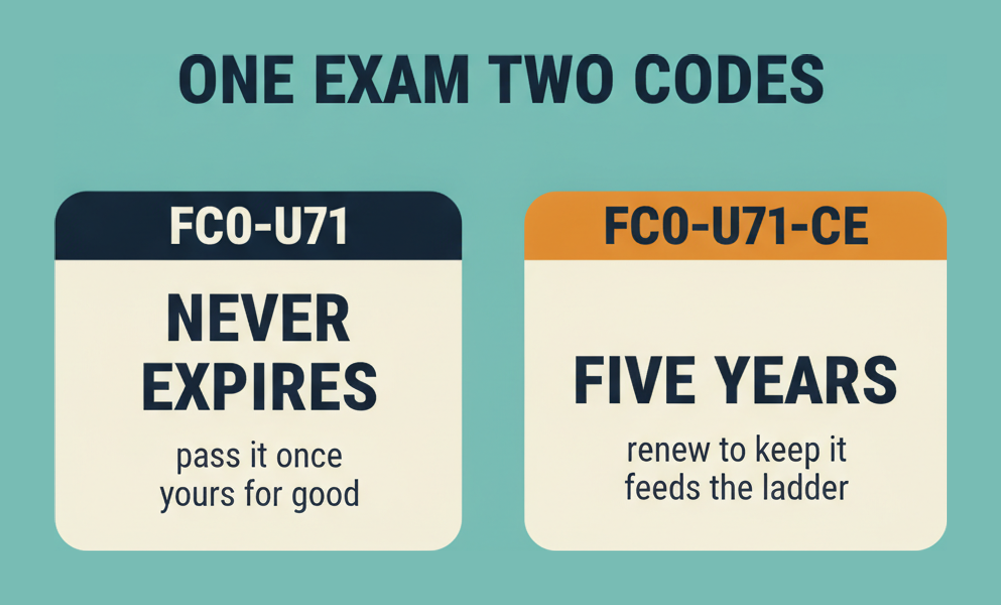
Put plainly, the non-expiring version is the simpler purchase for most people taking a foundational credential. You pass once, it is yours, and nothing lapses while you decide whether IT is the career you want. That is the whole point of an entry credential: it records that you covered this ground, and that fact does not stop being true after five years.
The continuing education version makes sense in a narrower case. If you already know you are heading further up CompTIA’s ladder, the continuing education scheme is how the later credentials are kept alive, and holding a CE-series certification puts you inside that machinery from the start. Some employers and training programmes that track renewal status prefer it for that reason.
Both codes are listed on the official Tech+ page. Check which one your voucher or booking actually refers to before you sit it, because the difference does not show up in the exam room. It shows up five years later.
What are the CompTIA Tech+ exam facts?
Tech+ is up to 70 multiple choice questions in 60 minutes, scored 650 on a scale of 900. It costs 129 USD, is delivered through Pearson VUE, and is available in English and Japanese. CompTIA states plainly that no prior experience is necessary.
| Field | Value |
|---|---|
| Exam name | CompTIA Tech+ |
| Exam series codes | FC0-U71 (no expiration) and FC0-U71-CE (valid five years) |
| Questions | Maximum of 70 |
| Question type | Multiple choice only |
| Duration | 60 minutes |
| Passing score | 650 on a scale of 900 |
| Price | 129 USD |
| Recommended experience | None required |
| Languages | English and Japanese |
| Launched | 16 July 2024 |
| Domains | 6, weighted 13, 24, 18, 13, 13 and 19 percent |
Two of those rows correct common assumptions. The question count is a maximum rather than a fixed number, which CompTIA states directly. And the paper is multiple choice only, with no performance-based items, which is a real difference from CompTIA’s higher credentials where simulations carry significant weight.
A minute per question sounds tight and is not, at this level. The questions test whether you recognise a concept rather than whether you can work something out, so most candidates finish with time in hand. Booking runs through the Pearson VUE channel, in a test centre or online.
One figure to confirm yourself: CompTIA does not publish a price on its own exam page, so treat 129 USD as the catalogue figure and check it at checkout. No retirement date is published either, so this guide does not guess one.
What do the six domains weigh?
Six domains, all weighted, and the weights are not even. Infrastructure takes 24 percent and security 19 percent, while software development and data fundamentals take 13 percent each. IT concepts take 13 percent and applications and software 18 percent.
| Domain | Weight | What it covers |
|---|---|---|
| IT Concepts and Terminology | 13% | Input, processing, output and storage; notational systems |
| Infrastructure | 24% | Computing devices and their purposes, and the infrastructure beneath them |
| Applications and Software | 18% | Operating system components, filesystems, compression, encryption, file management |
| Software Development Concepts | 13% | Interpreted, scripting, markup, compiled and query language categories |
| Data and Database Fundamentals | 13% | Data as an asset, critical against non-critical data, capture and correlation |
| Security | 19% | Confidentiality, integrity and availability; privacy across email, social and file sharing |
The practical reading is that roughly two questions in five come from infrastructure and security combined, and roughly one in four from software development and data combined. If your study time is limited, that ratio is the instruction.
It is also worth knowing how the questions feel before you plan, because candidates at this level routinely misjudge the depth. Working through a set of Tech+ sample questions early tells you whether you are over-preparing, which at 129 USD is a more common mistake than under-preparing.
Why do infrastructure and security carry 43 percent?
Because they are what an entry-level technology role actually touches first. Between them they take 43 percent of the paper, against 26 percent for software development and data combined, and that ratio reflects the jobs Tech+ is designed to open rather than an abstract view of what computing is.
Infrastructure, at 24 percent, is the single largest domain. It covers common computing devices and what each is for, spanning smartphones, tablets, e-readers, laptops and workstations, along with the infrastructure they connect to, which in practice means the wired and wireless networks defined by the IEEE 802 committee. The examinable skill is matching a device or component to a purpose, not configuring anything.
Security at 19 percent is the second largest, and it is conceptual rather than technical. Confidentiality, integrity and availability as a framework, then privacy applied to the places ordinary users leak it: social networking sites, email and file sharing. Expect scenarios describing an everyday situation and asking which principle it breaches.
The takeaway for planning is that Tech+ is a technology literacy credential with a defensive bias, not a programming primer. If you arrived expecting to be tested mainly on writing code, the blueprint has the emphasis the other way round, and studying to the weightings will feel counterintuitive for the first few sessions.
Concepts, software and data
The remaining three domains take 44 percent together and are the ones that build vocabulary. IT concepts and terminology at 13 percent, applications and software at 18 percent, and data and database fundamentals at 13 percent. None is difficult; all are easy to skim and then lose marks on.
IT concepts frames computing as input, processing, output and storage, and adds notational systems, which is where binary and hexadecimal appear. This is the domain most likely to be dismissed as obvious and then answered carelessly. Know the model well enough to place an unfamiliar device into it.
Applications and software is the larger of the three at 18 percent, covering operating system components, filesystem characteristics including compression and encryption, file types and extensions, and file management. It rewards anyone who has actually organised files on a machine rather than only used applications.
Software development concepts asks you to compare and contrast language categories: interpreted, scripting, markup, compiled and query languages. You are not asked to write any of them. The distinction between a markup language and a programming language is a standard trip hazard, and the bodies that define web markup, such as the W3C standards group, are a useful sanity check on what markup actually is.
Data and database fundamentals closes the set, covering data and information as an asset, critical against non-critical data, data-driven business decisions, data capture and collection, and data correlation. It is business-facing rather than technical, and the questions tend to ask why data matters to an organisation rather than how a database works.
Who should take Tech+?
People starting out, and CompTIA says so without hedging: no prior experience is necessary. That makes it a genuine entry point rather than a credential that quietly assumes a year in a help desk role, which is the trap with several nominally entry-level certifications.
It fits three groups particularly well. Career changers who need something on paper before a first technical application. Students and apprentices who want structure around self-taught knowledge. And people in adjacent roles, such as administration, sales or support, whose work now touches technology enough that the vocabulary has become a liability.
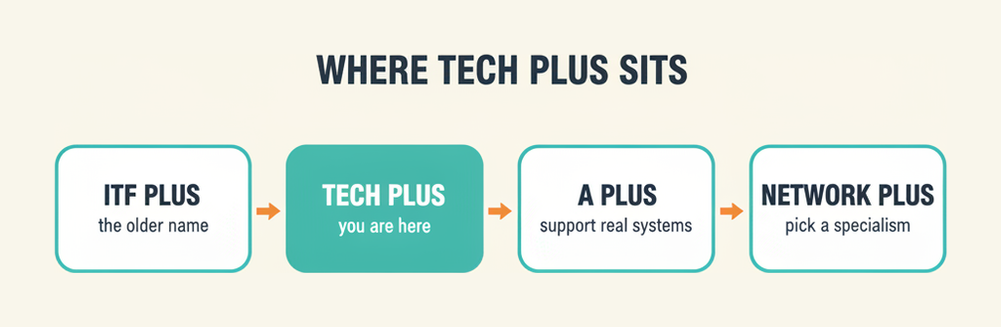
It fits poorly if you already work in IT. At 129 USD it is cheap, but a working technician will find most of it familiar, and the time is better spent on the A+ credential, which is the usual next step and is pitched at someone who supports systems rather than someone learning what they are.
Anyone who previously looked at IT Fundamentals is in the right place: Tech+ is its successor, under a new name and a new code. If you want the question style before committing, the site’s FC0-U71 study guide covers what the exam looks like in practice.
How should you prepare?
Study to the weightings, stop when the practice questions stop surprising you, and do not over-prepare. The most common error with Tech+ is treating it like a technical exam and studying for months, when the blueprint asks for recognition and vocabulary rather than hands-on competence.
- Decide which exam series code you want before buying, since FC0-U71 never expires and FC0-U71-CE runs for five years.
- Give infrastructure and security the largest share of your time, because together they are 43 percent of the paper.
- Learn the input, processing, output and storage model well enough to place any unfamiliar device inside it.
- Practise the language categories until you can separate markup from scripting from compiled without hesitating.
- Work through the security domain as everyday scenarios rather than as technical controls, since that is how it is framed.
- Sit a timed set of questions early to calibrate the depth, then study only what it exposed.
Practice at this level serves a different purpose than it does on a professional exam. There, it measures readiness. Here, it mostly tells you to stop revising, and an honest look at practice test strategy is worth more than another pass through the notes.
Frequently Asked Questions
How many questions are on the FC0-U71 exam?
A maximum of 70, all multiple choice, in 60 minutes.
What is the passing score for CompTIA Tech+?
Six hundred and fifty on a scale of 900. It is a scaled score, not a percentage.
What is the difference between FC0-U71 and FC0-U71-CE?
They are two exam series codes for the same exam. FC0-U71 carries no expiration, while FC0-U71-CE is valid for five years and sits inside CompTIA’s continuing education scheme.
How much does Tech+ cost?
One hundred and twenty nine US dollars as listed. CompTIA does not publish a price on its own exam page, so confirm the figure when you book.
Do I need experience before taking it?
No. CompTIA states that no prior experience is necessary, which makes it a genuine entry point.
What are the six domains and their weightings?
IT concepts and terminology at 13 percent, infrastructure at 24 percent, applications and software at 18 percent, software development concepts at 13 percent, data and database fundamentals at 13 percent, and security at 19 percent.
Are there performance-based questions?
No. Tech+ is multiple choice only, unlike several of CompTIA’s higher credentials.
Is Tech+ the same as ITF+?
Tech+ is the successor to IT Fundamentals. Same lineage, new name, new code and a revised blueprint.
What languages is the exam offered in?
English and Japanese.
What should I take after Tech+?
A+ is the usual next step, aimed at someone supporting systems rather than learning what they are.
Conclusion
Tech+ is a technology literacy credential with a defensive bias. Up to 70 multiple choice questions in 60 minutes, 650 on a scale of 900 to pass, 129 USD, no experience required, and six domains in which infrastructure and security carry 43 percent between them.
Make the code decision first, because it is the only one with consequences beyond exam day: FC0-U71 never expires, FC0-U71-CE runs five years inside the continuing education scheme. Then study to the weightings rather than to your interests, which for most newcomers means more time on devices and defence and less on code.
Calibrate early with timed questions and stop when they stop catching you out. This is an exam where over-preparing is the likelier mistake, and where the real value is the vocabulary you keep afterwards rather than the certificate itself.