A bank of CySA+ practice questions is only useful if it asks you things the way CS0-004 does, and very few candidates ever check whether it does. The current CompTIA Cybersecurity Analyst exam mixes multiple choice items with performance-based questions, and many of its marks sit behind objectives that hand you evidence and ask what it means.
This guide looks at the exam from the question side rather than the topic side. It shows how the wording of each objective predicts the kind of item you will see, what a CySA+ performance-based question asks you to do, which tools and outputs appear as evidence, how to tell good practice material from bad, and which version your practice should target while CS0-003 and CS0-004 overlap.
How Does the CS0-004 Exam Ask Its Questions?
CompTIA CySA+ CS0-004 asks a maximum of 85 questions in 165 minutes, combining multiple choice items with performance-based questions, and you need a scaled score of 750 on a scale of 100 to 900 to pass. The questions are spread across four weighted domains, so every practice session should reflect that same mix of formats and topics.
| Exam detail | CS0-004 (CySA+ V4) |
|---|---|
| Exam name | CompTIA Cybersecurity Analyst (CySA+) |
| Exam code | CS0-004 |
| Launch date | June 23, 2026 |
| Number of questions | Maximum of 85 |
| Question types | Multiple choice and performance-based |
| Duration | 165 minutes |
| Passing score | 750 on a scale of 100 to 900 |
| Exam price (US retail voucher) | $425 |
| Delivery | Pearson VUE |
| Languages | English, with French, Japanese, Spanish and Portuguese coming |
Two details in that table change how you should practise. The first is the word maximum: CompTIA states an upper limit rather than a fixed count, so do not plan your pacing around exactly 85 items. The second is the scaled score. A 750 is not a fixed percentage of correct answers, so a practice test that reports “75 percent” tells you very little about whether you would pass the real thing.
How the marks are spread
The four domains carry fixed weights: Security Operations 34 percent, Vulnerability Management 26 percent, Incident Response and Management 24 percent, and Reporting and Communication 16 percent. A practice set that is mostly incident response trivia, or mostly vulnerability scanning, is training you for a different exam. CompTIA lists the same figures, along with the launch date and the recommended experience of about four years in a SOC analyst or vulnerability analyst role, on its official CySA+ V4 page.
What Do the Objective Verbs Reveal About Question Types?
Each CS0-004 objective opens with a verb that signals the kind of question behind it. Six of the fifteen objectives begin with “Given a scenario”, which means you will be shown a situation and asked to analyze it, choose a tool, or take an action. The other nine ask you to explain or summarize a concept, which points to shorter recall and comparison items.
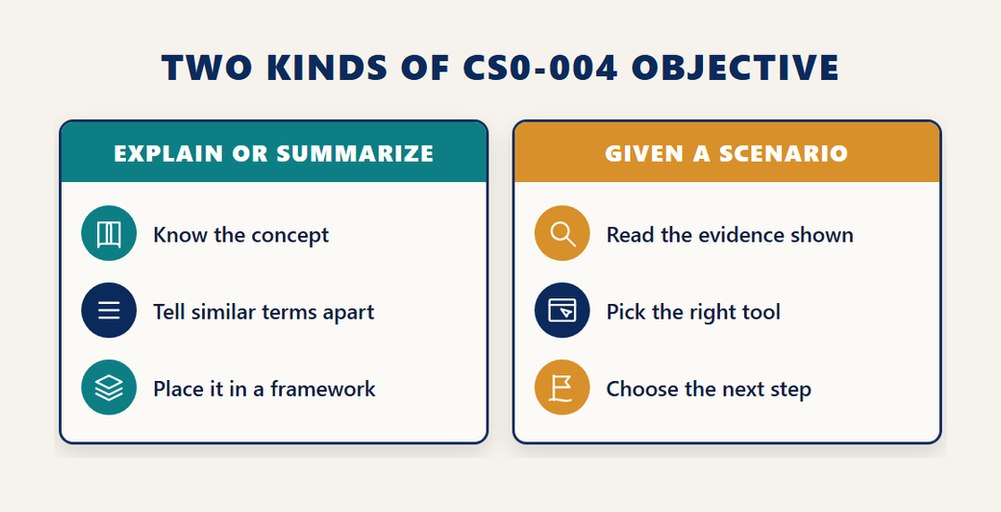
| Domain | “Given a scenario” objectives | Explain or summarize objectives |
|---|---|---|
| Security Operations (34%) | Analyze indicators of potential malicious activity; use tools to determine malicious activity | Architecture concepts; threat intelligence and threat hunting; efficiency and process improvement; AI in security operations |
| Vulnerability Management (26%) | Implement the appropriate scanning method; analyze output from assessment tools; analyze data to prioritize and mitigate vulnerabilities | Control types, risks and vulnerability management |
| Incident Response and Management (24%) | Implement incident response techniques | Attack methodology frameworks; the incident response process |
| Reporting and Communication (16%) | None | Vulnerability management reporting; security operations and incident response reporting |
Reading a scenario objective
Vulnerability Management is the most scenario-heavy domain: three of its four objectives start with “Given a scenario”. Expect stems that show scanner output, a list of findings with scores, or a description of an environment, followed by a question about which scan to run or which finding to fix first. Knowing the definition of a credentialed scan is not enough; you need to recognise when a situation calls for one.
Reading a recall objective
Reporting and Communication has no scenario objective at all, yet its items still test judgement. Its topics are lists to know cold: metrics such as mean time to detect and mean time to respond, inhibitors to remediation such as legacy systems and business process interruption, and the stakeholders a communication plan names. Questions here usually ask you to match a need to the right report, metric or audience.
If you want to see how this wording turns into actual items, work through the CS0-004 sample questions and label each one as a recall item or a scenario item before you answer it.
What Is a CySA+ Performance-Based Question Like?
A CySA+ performance-based question is a simulation: an approximation of a tool or environment, such as a terminal window, log viewer or network diagram, in which you complete a task rather than pick one answer. CompTIA lists CySA+ among its exams with simulation PBQs, and its V4 guidance says these items may ask you to analyze SIEM alerts, review logs, investigate indicators of compromise or prioritize vulnerabilities.
The rules that matter on exam day
- Simulation PBQs fill the whole testing area and have a reset button that clears your work on that item.
- You can skip a simulation PBQ and come back to it later, and your work is saved as you move between items.
- There can be more than one valid way to solve the task, and scoring accounts for different approaches.
- Partial credit is possible, so a half finished simulation is worth more than a blank one.
CompTIA explains each of these rules on its performance-based questions page, which also offers a sample simulation to try. The sample is not taken from any CompTIA exam, but it shows the interface before you meet it under time pressure.
The tasks CompTIA names for V4
CompTIA’s own description of CySA+ V4 says performance-based items may require you to analyze SIEM alerts, review logs and security events, investigate indicators of compromise, prioritize vulnerabilities, support incident response activities and recommend remediation actions. Every one of those is a reading task first. The simulation gives you data, and the marks go to the analyst who interprets it correctly, not to the one who remembers the most acronyms.
Which Tools and Outputs Show Up as Evidence?
The CS0-004 syllabus names specific tools and file formats, and those are the outputs most likely to appear inside a scenario stem or simulation. Security Operations lists packet analysers, SIEM, threat intelligence platforms, file analysis and sandboxing tools, while Vulnerability Management lists scanners and cloud assessment tools whose reports you must read and rank.
Security Operations evidence
The objective on using tools names Wireshark, tcpdump, Snort, Suricata and Zeek for packet analysis, CyberChef for decoding, VirusTotal, Strings and YARA for file analysis, and WHOIS and AbuseIPDB for domain and IP reputation. It also lists the formats you must read: JSON, XML, YAML and EVTX, plus Python, PowerShell and shell script. A realistic practice question shows you a decoded command line or a Windows event and asks what it indicates, which is why the syllabus also names Living Off the Land binaries and interpreting suspicious commands.
Vulnerability Management evidence
Here the named tools include Nmap, Nessus, OpenVAS, Nuclei, Burp Suite, ZAP and Nikto, along with cloud assessment tools such as ScoutSuite, Prowler, Trivy and Checkov. The prioritisation objective lists the criteria you weigh: exploitability, active exploitation, asset value, impact and patch availability, scored with CVSS metrics and the Exploit Prediction Scoring System. CompTIA’s V4 material singles out EPSS-based prioritisation as expanded coverage, so expect items that set a high CVSS score against a high likelihood of exploitation and ask which to fix first.
Incident Response evidence
The frameworks objective names the Cyber Kill Chain, the Diamond Model of Intrusion Analysis and MITRE ATT&CK. A scenario may describe attacker behaviour and ask where it sits in a framework, so practise mapping observed actions to the tactics and techniques in the MITRE ATT&CK knowledge base rather than memorising the matrix. The techniques objective adds chain of custody, legal hold, timeline building and root cause analysis, all of which tend to appear as “what should the analyst do next” questions.
How Should You Judge a Set of CySA+ Practice Questions?
Good CySA+ practice questions match the CS0-004 objectives, use scenario stems with real looking output, include performance-based tasks, and explain why every wrong option is wrong. Weak sets recycle CS0-003 content, test only definitions, and promise “actual exam questions”, which CompTIA treats as unauthorized material that can cost you the certification.
A five point check
- V4 coverage: look for items on AI risks and governance, ZTNA and SASE, SBOM and EPSS. A set with none of these was probably written for CS0-003.
- Scenario share: six of the fifteen objectives, including three of the four in Vulnerability Management, are scenarios, so a large share of items should show you a situation, not just a term.
- Simulations: some practice should be interactive, because a PBQ cannot be rehearsed as a multiple choice item.
- Explanations: every answer should explain the right option and the wrong ones, since the review is where most of the learning happens.
- Domain balance: the mix should roughly follow the 34, 26, 24 and 16 percent weighting.
Why dumps are a bad bet
Searches for CS0-004 dumps are common, but CompTIA’s position is direct. Its unauthorized training materials FAQ lists copies of real exam questions and brain dump sites as unauthorized, warns that using them can mean losing the certification and being barred from future exams, and offers a Training Resource Review Tool for checking a resource before you study with it. CompTIA also warns that such material can be incorrect or outdated, so it fails even on its own terms.
CS0-003 or CS0-004: Which Version Should Your Practice Target?
Target CS0-004 unless your exam is booked before CS0-003 closes. CompTIA calls CS0-003 the retiring version: its English exam retires on December 22, 2026, its English learning products on November 22, 2026, and its translations on March 23, 2027. CS0-004 launched on June 23, 2026 and is the version with current content.
The two versions share the same four domains and the same weights, which is why older practice material looks almost right. The differences are in the detail, and that is exactly where questions are written. CompTIA describes V4 as adding dedicated coverage of AI use cases, risks and governance, expanded ZTNA and SASE, EPSS-based prioritisation, and stronger SBOM and software supply chain coverage. Practice written for CS0-003 will leave those items untouched.
For a domain-by-domain walk through what changed and how to weight your study time, read our CS0-004 domains guide. Use it to plan the topics, and use the routine below to practise the questions.
A Practice Routine Built Around Question Types
A useful CySA+ practice routine treats each question as a reading exercise first and a knowledge check second. Classify the item, read the evidence before the options, decide what is most likely happening, and then review every miss by asking whether you lacked the knowledge or misread the data, because those two failures need different fixes.
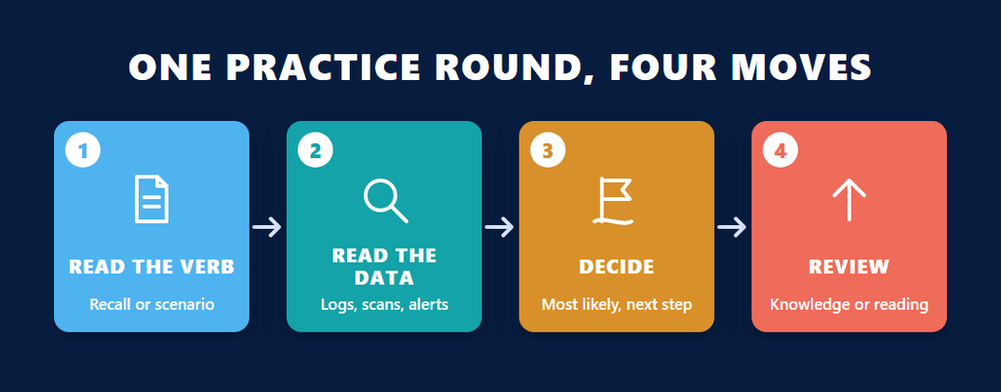
- Classify each question as a recall item or a scenario item before reading the answer options.
- Read the evidence in the stem, such as the log line, scan result or alert, and note what it shows before looking at the choices.
- Decide what is most likely happening or what the analyst should do next, then pick the option that matches your own conclusion.
- Review every wrong answer and record whether the cause was missing knowledge or misreading the evidence.
- Rework the misread items with fresh output from the tools the syllabus names, and the knowledge gaps against the objective they came from.
- Sit at least one timed full length set late in your preparation, skipping any simulation that stalls you and returning to it at the end.
The last step matters because the clock is generous but not unlimited. With a maximum of 85 items in 165 minutes you have a little under two minutes per item on average, and a stubborn simulation can eat several of those. Since simulations can be skipped and work is saved, leaving one for the end is a legitimate tactic rather than a gamble.
If you are weighing whether the credential suits your role at all before investing in practice, our look at CySA+ for analyst careers covers the jobs it maps to.
Frequently Asked Questions
How many questions are on the CySA+ CS0-004 exam?
CompTIA states a maximum of 85 questions, combining multiple choice and performance-based items, to be completed in 165 minutes.
Does CS0-004 have performance-based questions?
Yes. CySA+ is on CompTIA’s list of exams with simulation performance-based questions, which ask you to complete a task in a simulated tool or environment rather than choose one answer.
Can I skip a performance-based question on CySA+?
Yes. CompTIA says simulation PBQs can be skipped and returned to later, and your work is saved when you move to another item.
Is partial credit given on CySA+ simulations?
CompTIA says partial credit may be given on simulation PBQs and that scoring accounts for different valid approaches to the same task.
What score do I need to pass CS0-004?
You need 750 on a scale of 100 to 900. It is a scaled score, so it does not convert neatly into a fixed number of correct answers.
Are CS0-003 practice questions still useful for CS0-004?
Partly. The four domains and weights are the same, but CS0-004 adds AI in security operations, ZTNA and SASE, EPSS prioritisation and more SBOM coverage, which older practice will not include.
When does CS0-003 retire?
CompTIA lists December 22, 2026 for the English CS0-003 exam and March 23, 2027 for its translated versions.
Is it safe to study from CS0-004 dumps?
No. CompTIA treats copies of real exam questions as unauthorized material, and using them can lead to losing the certification and being barred from future exams.
How much does the CySA+ V4 exam cost?
CompTIA gives a US retail voucher price of $425 for CySA+ V4, and offers bundles that combine a voucher with training or a retake.
Conclusion
CySA+ practice questions pay off when they look like the exam they are preparing you for. CS0-004 gives you a maximum of 85 items in 165 minutes, and six of its fifteen objectives open with “Given a scenario”, so a large share of the marks go to reading evidence and choosing the next step. Pick practice that covers the V4 additions, includes simulations and explains every option, skip anything that claims to be the real exam, and target CS0-004 unless your booking falls before CS0-003 retires in December. Then practise the way the exam asks: read the verb, read the data, decide, and review.