Picture a systems administrator on an ordinary Tuesday. The payroll application runs in one public cloud, the analytics team has quietly built its pipelines in a second, and the file servers still sit in a rack down the corridor. A deployment fails at 10 am, and nobody is sure whether the cause is a route table, a permission or a service quota. Whose console does the answer live in?
That mixed estate is the job the CompTIA Cloud+ certification was written for. Its exam, CV0-004, asks up to 90 questions in 90 minutes across six domains, and not one objective names a cloud provider. It tests whether you can design, deploy, run, secure and repair cloud systems wherever they happen to be hosted. This guide covers what the exam asks, how the six domains are weighted, where it sits beside provider exams, and how to prepare for it.
What Is the CompTIA Cloud+ Certification?
The CompTIA Cloud+ certification is a vendor-neutral credential for people who operate cloud infrastructure. Its current exam, CV0-004, is the fourth version and launched on 24 September 2024. It covers cloud architecture, deployment, operations, security, DevOps fundamentals and troubleshooting, and CompTIA recommends two to three years of hands-on work as a systems administrator or cloud engineer first.
Vendor neutral has a precise meaning here. The objectives describe concepts every major platform shares, such as availability zones, virtual private clouds, object storage and identity federation, without tying them to one company’s product names. The products it does name are tools that run on any cloud, such as Terraform, Kubernetes and Jenkins. CompTIA’s position is that an operator who understands the concept can find it in any console.
“Businesses need to ensure that their teams have the skills to manage cloud and hybrid environments. CompTIA Cloud+ gives team members the ability to manage complex migrations, oversee multi-cloud environments, secure data, and troubleshoot while maintaining cost-effective operations.”
That statement comes from CompTIA’s Cloud+ launch announcement, which also lists who the credential is aimed at: cloud administrators, systems engineers, cloud specialists and cloud engineers, along with Linux, server and network administrators who are being handed cloud work. The same announcement states that Cloud+ complies with the ISO 17024 standard and is approved by the US Department of Defense under directive 8140.
What Does the CV0-004 Exam Look Like?
CV0-004 allows a maximum of 90 questions in 90 minutes, mixing multiple choice with performance-based questions. The passing score is 750 on a scale of 100 to 900, the exam price is 399 US dollars, and it is booked through Pearson VUE. CompTIA offers it in English and Japanese.
| Field | CV0-004 detail |
|---|---|
| Exam | CompTIA Cloud+, version V4 |
| Exam code | CV0-004 |
| Questions | Maximum of 90, multiple choice and performance-based |
| Duration | 90 minutes |
| Passing score | 750 on a scale of 100 to 900 |
| Price | 399 US dollars |
| Delivery | Pearson VUE |
| Languages | English and Japanese |
| Recommended experience | 2 to 3 years hands-on as a systems administrator or cloud engineer |
| Launch and retirement | Launched 24 September 2024; retirement estimated 2027 |
The version, question limit, timing, pass mark, languages and dates are the ones CompTIA publishes on its official Cloud+ page. The recommended experience is guidance, not an entry requirement, so nothing stops you booking the exam without it.
Two of those figures deserve a second look. The pass mark of 750 is high by CompTIA’s own standards: A+ Core 2 asks for 700 and Network+ for 720, both on a 900 point scale. And because the score is scaled, 750 does not mean 83 percent of questions answered correctly. With one minute per question at the upper limit, and performance-based questions taking longer than a single click, pacing is part of the exam.
How Are the Six Cloud+ Domains Weighted?
CV0-004 has six domains. Cloud Architecture is the largest at 23 percent, Deployment and Security carry 19 percent each, Operations 17 percent, Troubleshooting 12 percent and DevOps Fundamentals 10 percent. The three largest domains together make up 61 percent of the exam, so design, build and protect outweigh everything else.
| Domain | Weight | What it centres on |
|---|---|---|
| Cloud Architecture | 23% | Service models, availability, networking, storage, containers, virtualization, cost |
| Deployment | 19% | Deployment models and strategies, migration, infrastructure as code, provisioning |
| Operations | 17% | Observability, scaling, backup and recovery, resource life cycle |
| Security | 19% | Vulnerability management, compliance, identity and access, controls, attack monitoring |
| DevOps Fundamentals | 10% | Source control, CI/CD pipelines, system integration, DevOps tools |
| Troubleshooting | 12% | Deployment, network and security issues |
The wording of the objectives tells you as much as the weights. Many begin with “Given a scenario”, which is CompTIA’s signal that the question will describe a situation and ask what you would do. Others begin with “Explain” or “Compare and contrast”, which test whether you can tell two similar ideas apart. Operations is written almost entirely as scenarios, while Cloud Architecture leans on explanation and comparison.
To see how those scenario questions read before you commit to a study plan, the EduSum CV0-004 sample questions page sets out a short set in the exam’s style, including the choose-two format that catches candidates who stop at the first correct option.
What Does Cloud Architecture Cover at 23 Percent?
Cloud Architecture is the widest domain on CV0-004, with eleven objectives. It runs from service models and the shared responsibility model through availability, networking, storage, cloud-native design, containers, virtualization, cost, databases and workload optimization, and ends with evolving technologies such as machine learning and the Internet of Things.
Service models and availability
The domain opens with the four service models named in the objectives: infrastructure, platform, software and function as a service. From there it moves to availability, where you need to tell a region from an availability zone, explain cloud bursting and edge computing, and separate recovery time objective from recovery point objective. Hot, warm and cold disaster recovery sites are all listed by name.
Networking and storage
Networking covers how you connect to a cloud, by VPN or dedicated connection, and what sits inside it: application and network load balancers, content delivery networks, firewalls, virtual private clouds, peering and transit gateways. Routing topics include VLANs, software-defined networking, BGP, static routes and route tables. Storage is tested as a set of comparisons:
- Tiers: hot, warm, cold and archive
- Disk types: solid-state and hard disk drives
- Storage types: object, block and file
- The performance and cost implications of each choice
Containers, virtualization and cost
Two “compare and contrast” objectives sit side by side. One covers containers: stand-alone against orchestrated workloads, port mapping, persistent volumes against ephemeral storage, and image registries. The other covers virtualization: clustering, cloning, host affinity, hardware pass-through, overlay networks and SAN or NAS storage. Cost has its own objective too, with billing models such as reserved resources, pay-as-you-go and spot instances, plus tagging and rightsizing.
Evolving technologies
The last architecture objective is to identify evolving technologies in the cloud. On the AI side the objectives list text recognition, translation, visual recognition, sentiment analysis, voice-to-text, text-to-voice and generative AI. On the IoT side they list sensors, gateways, communication and transmission protocols. The verb is “identify”, so expect recognition questions here, not design work.
Deployment: Migration, Release Strategies and Infrastructure as Code
Deployment carries 19 percent of CV0-004 across five objectives: comparing public, private, hybrid and community deployment models, choosing a deployment strategy, summarizing cloud migration, using code to deploy and configure resources, and provisioning the right resources for a stated set of requirements. Two are written as scenarios, and a third starts from a stated set of requirements.
Four ways to release a change
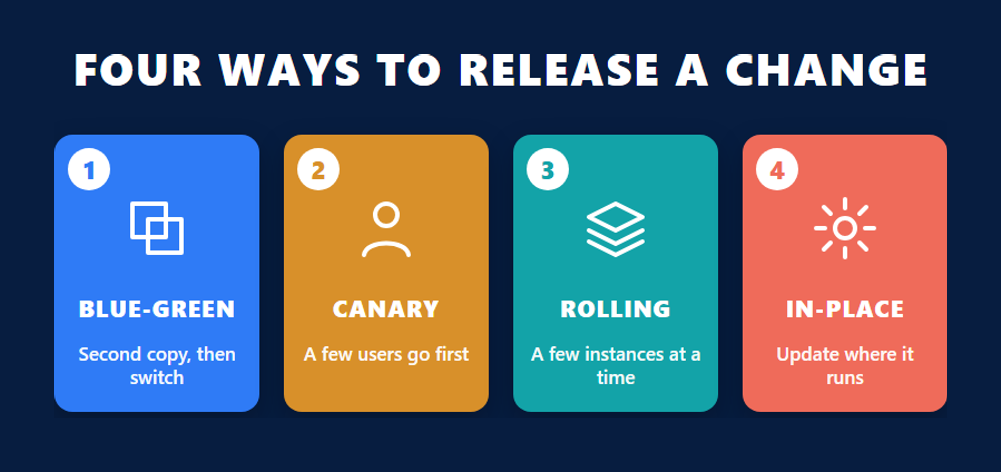
The objectives name four deployment strategies, and you are expected to pick the right one for a situation. Blue-green runs a second complete environment and switches traffic across, which makes rollback fast but briefly doubles the footprint. Canary sends a small share of users to the new version first. Rolling replaces instances a few at a time. In-place updates the running system where it stands.
Migration types and strategies
Migration is tested in three directions: on premises to cloud, cloud to on premises, and cloud to cloud. The objectives then list what to weigh before moving, including platform compatibility, management overhead, vendor lock-in, regulatory and compliance limits, and even power and cooling. Six application migration strategies appear by name: rehost, replatform, re-architect, retain, retire and refactor.
Code as the deployment tool
One objective asks you to use code to deploy and configure cloud resources. It covers infrastructure as code and configuration as code, basic scripting logic (variables, conditionals, operators, data types and functions), and the JSON and YAML formats. It also names the habits that make code trustworthy in production: repeatability, drift detection, versioning, testing and documentation.
What Do Operations and Security Ask You to Do?
Operations at 17 percent and Security at 19 percent together make up 36 percent of CV0-004. Operations is four scenario objectives on observability, scaling, backup and recovery, and resource life cycle. Security has six objectives covering vulnerability management, compliance, identity and access management, best practices, security controls and spotting common attacks.
Operations: keeping it running
Every Operations objective begins with “Given a scenario”. Observability means configuring logging (collection, aggregation and retention), tracing, monitoring and alerting. Scaling means choosing between triggered, scheduled and manual approaches and between horizontal and vertical types. Backup covers full, incremental and differential types, on-site and off-site locations, replication, encryption and testing for recoverability and integrity. Life cycle covers patches, major and minor updates, and decommissioning at end of life or end of support.
Security: named standards and real controls
The compliance objective lists the standards a cloud operator meets in audits: SOC 2, PCI DSS and ISO 27001, along with the Cloud Security Alliance, whose Cloud Controls Matrix maps cloud-specific controls to those frameworks. It also covers data sovereignty, ownership, locality, classification and retention, including litigation hold.
Identity and access management is the most detailed objective in the domain. It separates access to the management environment (API, SDK, command line and web portal) from access to the resources themselves (SSH, RDP and bastion hosts), then lists authentication models such as federation, SAML, multifactor authentication and OpenID Connect, and authorization models including role-based access control and OAuth 2.0.
The best practices objective names Zero Trust, hardening, secrets management, least privilege and container security. Under benchmarks it names the Center for Internet Security, which publishes free CIS hardening benchmarks for operating systems, container platforms and cloud services. Reading one is the quickest way to see what “hardening” means line by line. The final security objective asks you to recognize attacks from monitoring data, including ransomware, DDoS, cryptojacking and zombie instances.
How Do DevOps Fundamentals and Troubleshooting Fit In?
DevOps Fundamentals is the smallest CV0-004 domain at 10 percent and Troubleshooting follows at 12 percent. DevOps is tested as concepts: source control, CI/CD pipelines, system integration and a named list of tools. Troubleshooting is tested as scenarios on deployment, network and security issues, and draws on every other domain.
DevOps Fundamentals
All four DevOps objectives begin with “Explain”, so the exam wants understanding, not pipeline engineering. Source control covers commits, pushes, pull requests, code review, merges and branch management. The CI/CD objective covers build, testing, artifacts such as VM and container images, and public and private repositories. Integration covers event-driven architectures, REST, SOAP, RPC, web sockets and GraphQL. The tools objective is a plain list:
- Ansible
- Docker
- The Elasticsearch, Logstash and Kibana (ELK) stack
- Git and GitHub Actions
- Grafana
- Jenkins
- Kubernetes
- Terraform
The objective asks you to explain the importance of each tool, so know what job each one does and where it sits in a pipeline. You are not asked to write a playbook or a manifest from memory.
Troubleshooting
Troubleshooting has three scenario objectives. Deployment issues include misconfigurations, oversubscription, API throttling, service quotas and regional service availability. Network issues include DHCP, DNS, NTP and NAT failures, HTTP status codes, missing or misconfigured routes, IP scope exhaustion and VLAN tagging mistakes. Security issues include deprecated cipher suites, privilege escalation, leaked credentials and unauthorized software. Almost every item is a concept from an earlier domain, seen at the moment it breaks.
Should You Take Cloud+ or a Provider Certification?
Take the CompTIA Cloud+ certification when your work spans more than one platform, or when you do not yet know which platform your next employer runs. Take a provider certification when you work deep inside one cloud every day. Cloud+ proves the concepts and operating practice; a provider exam proves fluency in one vendor’s services. Many administrators end up holding both.
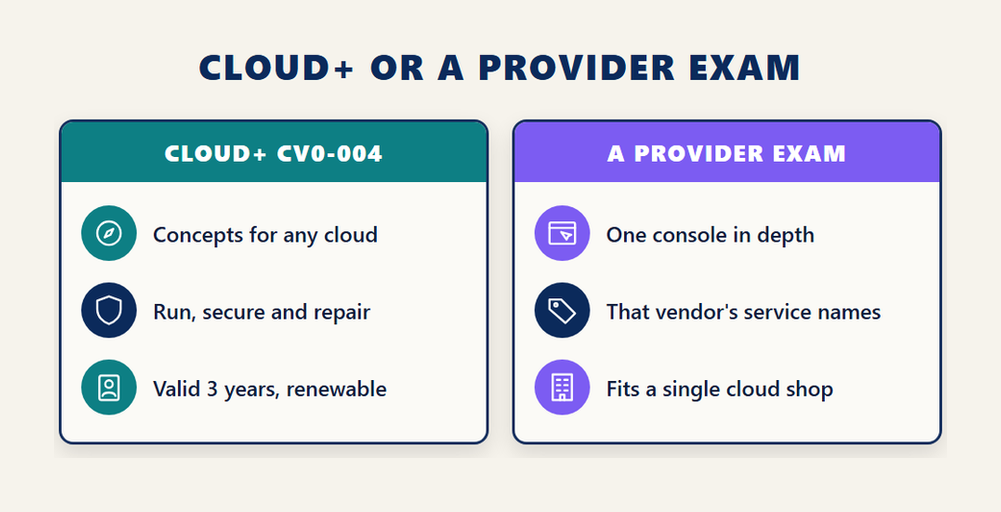
The two kinds of exam answer different questions from a hiring manager. A provider credential says you know where things are in that company’s console and what its services are called. Cloud+ says you understand why a transit gateway exists, when a canary release beats a rolling one, and how to read a failed deployment, whichever logo is on the screen. For someone moving from server or network administration into cloud operations, that conceptual layer is usually the missing piece.
Three situations favour Cloud+ in particular:
- Your organization runs a hybrid or multi-cloud estate and you support all of it
- You work in or with US defence organizations, where CompTIA states Cloud+ is approved under DoD directive 8140
- You already hold Network+ or Server+ and want a next step that builds on general infrastructure skills
One question comes up often: how Cloud+ differs from CompTIA Cloud Essentials. Cloud+ is a proctored technical certification for practitioners. CompTIA now presents Cloud Essentials as a self-paced course of about eight hours for business professionals, ending in a competency certificate. If you configure or support cloud systems, Cloud+ is the one that matches the work.
How Long Does Cloud+ Last, and What Comes After It?
Cloud+ is valid for three years from the date you certify. It sits inside CompTIA’s Continuing Education programme, so you can renew without retaking the exam by earning Continuing Education Units within the three-year cycle and paying a CE fee. If it lapses, CompTIA requires you to pass the latest exam version to regain it.
CompTIA’s certification renewal policy lists Cloud+ among the credentials that carry the “ce” designation. It also sets a 30-day grace period after expiry for paying outstanding fees or submitting units you earned inside the original cycle. Activities completed after the cycle ends do not count, so the grace period is for paperwork, not for catching up.
The exam version has its own clock, separate from your certificate. CompTIA usually retires an exam about three years after launch and estimates 2027 for CV0-004. A new version does not shorten an existing certification; it only changes which exam new candidates sit.
As for what follows, CompTIA positions CloudNetX as the step up for experienced holders of Cloud+ or Network+. It belongs to the Xpert Series, the top tier of the CompTIA catalogue. Our guide to the CloudNetX CNX-001 exam covers how that exam is built and who it suits.
How Should You Prepare for CV0-004?
Prepare for CV0-004 by working from the official objectives in weight order, with hands-on practice in at least one real cloud account. Start with Cloud Architecture, then Deployment and Security, then Operations, and treat Troubleshooting as revision of everything else. Finish with timed practice that includes performance-based questions.
- Read the CV0-004 objectives end to end and mark every term you could not explain to a colleague.
- Study Cloud Architecture first, building each networking and storage concept in a free-tier cloud account as you go.
- Work through Deployment by writing a small infrastructure as code template, changing it, and watching what the change does.
- Cover Security and Operations together, setting up logging, an alert, a backup and an access policy on the resources you built.
- Learn what each named DevOps tool is for, and trace one change from commit to deployment.
- Break your own environment on purpose, then fix it, to rehearse the Troubleshooting scenarios.
- Sit timed practice at one minute per question and review every wrong answer against its objective.
CompTIA estimates 25 to 40 hours for its CertMaster Learn course and 10 to 20 hours for CertMaster Practice. Those are durations for the vendor’s own products, not a promise about your total study time. With the two to three years of experience CompTIA recommends, much of the syllabus will be familiar ground; without it, plan for more lab time, because the scenario wording assumes you have seen these systems misbehave.
If you want a second view of the same objectives with resource suggestions, our CV0-004 exam breakdown walks through them in a different order.
Frequently Asked Questions
What is the passing score for CompTIA Cloud+?
CV0-004 requires 750 on a scale of 100 to 900. The score is scaled, so it does not convert directly into a percentage of questions answered correctly.
How many questions are on the CV0-004 exam?
CompTIA publishes a maximum of 90 questions, made up of multiple choice and performance-based questions, with 90 minutes to complete them.
What are the six Cloud+ domains?
Cloud Architecture 23 percent, Deployment 19 percent, Operations 17 percent, Security 19 percent, DevOps Fundamentals 10 percent and Troubleshooting 12 percent.
How much does the Cloud+ exam cost?
The exam price is 399 US dollars, and the exam is scheduled through Pearson VUE.
Does Cloud+ test AWS, Azure or Google Cloud?
No. The CV0-004 objectives name no cloud provider. They test concepts that apply across platforms, and the products named are cross-platform tools such as Terraform, Kubernetes, Docker and Jenkins.
Are there prerequisites for CompTIA Cloud+?
There are no required prerequisites. CompTIA recommends two to three years of hands-on experience as a systems administrator or cloud engineer.
How long is the Cloud+ certification valid?
Three years from the certification date. It can be renewed through CompTIA’s Continuing Education programme without retaking the exam.
What is the difference between Cloud+ and Cloud Essentials?
Cloud+ is a proctored technical certification for people who operate cloud infrastructure. CompTIA now presents Cloud Essentials as a self-paced course of about eight hours for business professionals, ending in a competency certificate.
When will CV0-004 retire?
CV0-004 launched on 24 September 2024. CompTIA usually retires exams about three years after launch and gives an estimate of 2027.
Conclusion
The CompTIA Cloud+ certification is built for the operator whose systems do not live in one place. CV0-004 gives you up to 90 questions and 90 minutes, asks for 750 on a 900 point scale, and spreads its six domains so that architecture, deployment and security carry 61 percent between them. Its objectives name tools, standards and concepts, and no provider. That makes it a strong fit for administrators moving into cloud operations and for anyone supporting a hybrid or multi-cloud estate, and a natural partner to a provider credential later. Start with the objectives, build what they describe in a real account, break it and repair it, and book the exam once timed practice feels routine.