Ten years of IT experience, five of them as a network architect. That is what CompTIA recommends before you sit CloudNetX, and it is a startling line to read from a body better known for the certifications people take in their first year. CNX-001 is not an entry point. It is the top of a ladder, and it is priced and scored accordingly.
The scoring is the part that changes how you prepare. There is no scaled score and no near miss to console you: the result is pass or fail. This guide covers what CloudNetX certifies, how its four domains divide 90 questions across 165 minutes, why troubleshooting takes a quarter of an architect exam, and whether the recommended experience is a real gate.
Table of Contents
- What Does CloudNetX Actually Certify?
- What Does the CNX-001 Exam Look Like?
- How Are the Four CloudNetX Domains Weighted?
- Why Does Architecture Design Carry the Largest Share?
- What Does Network Security Mean at Architect Level?
- Why Is Troubleshooting Worth a Quarter of an Architect Exam?
- What Does the Operations and Performance Domain Cover?
- What Experience Does CompTIA Expect You to Bring?
- Who Should Take CloudNetX?
- How Do You Prepare for a Pass or Fail Exam?
- Frequently Asked Questions About CloudNetX
- Conclusion
What Does CloudNetX Actually Certify?
CloudNetX certifies that you can design, secure, operate, and troubleshoot networks that span on premises infrastructure and more than one cloud provider. It is vendor neutral, which in a multi-cloud context is not a marketing line but a practical requirement, because the architectures it describes rarely live inside a single provider’s ecosystem.
The credential targets people who make decisions rather than implement them. You are expected to read a business requirement, choose an architecture, defend the choice, and know what will break later. That is a different skill from configuring the resulting design, and CNX-001 tests the former. Candidates not yet at architect level usually start with the CompTIA Cloud+ CV0-004 exam, which covers cloud operations across providers.
Newest Rather Than Legacy
CloudNetX launched on 18 February 2025 and is one of CompTIA’s newest certifications, built for hybrid and multi-cloud network architecture rather than retrofitted onto it. That matters because the material assumes distributed, provider-spanning designs as the default case rather than the exception.
What Does the CNX-001 Exam Look Like?
CNX-001 presents 90 questions in 165 minutes at a price of USD $544, delivered through Pearson VUE. The most consequential detail is the scoring: CloudNetX is graded pass or fail only, with no scaled score reported to you at all.
| Specification | Detail |
|---|---|
| Exam name | CompTIA CloudNetX |
| Exam code | CNX-001 |
| Number of questions | 90 |
| Duration | 165 minutes |
| Passing score | Pass or fail, no scaled score |
| Exam price | USD $544 |
| Delivery | Pearson VUE |
| Question types | Multiple choice and performance based |
| Language | English |
| Expected retirement | Usually three years after launch |
What Pass or Fail Changes
Without a scaled score you cannot calculate how close you came, and you cannot use a score report to target a retake. That removes the usual strategy of accepting weakness in a small domain and making it up elsewhere. Reading the full CloudNetX exam objectives before you plan is worth the time, because every domain has to be genuinely covered. A year later CompTIA launched a credential for a different frontier, the AI security credential.
How Are the Four CloudNetX Domains Weighted?
CNX-001 divides into four domains, and the split is flatter than most architect exams. No domain is negligible, and the smallest still carries 16 percent of a 90 question paper, which is roughly 14 questions.
| Domain | Weight |
|---|---|
| Network Architecture Design | 31% |
| Network Security | 28% |
| Network Troubleshooting | 25% |
| Network Operations, Monitoring, and Performance | 16% |
Design and security together make up 59 percent, but troubleshooting at 25 percent is the figure worth pausing on. CompTIA is asserting that an architect who cannot diagnose their own design is not an architect.
Why Does Architecture Design Carry the Largest Share?
Network Architecture Design is the largest CNX-001 domain at 31 percent, and its framing is consistent: given a scenario, analyse business requirements and apply the right networking concepts. Every objective starts from a requirement rather than from a technology, which is the distinction between architecture and configuration.
The Fundamentals It Assumes
The domain reaches back into material that looks associate level on paper and is examined at design depth here. Expect IPv4 and IPv6, subnetting, CIDR notation, and variable length subnet masking, alongside public against private and static against dynamic addressing.
- Address translation including port forwarding, port address translation, and NAT64
- Transport choices between TCP and UDP and what each costs
- Routing protocols, specifically OSPF and BGP, and how routing tables resolve
- Core services including DHCP, NTP, and DNS
- Authentication protocols as a design consideration rather than a setting
BGP deserves particular attention. In a multi-cloud design it is the protocol that makes provider interconnection work, and it is where scenario questions tend to concentrate.
What Does Network Security Mean at Architect Level?
Network Security carries 28 percent of CNX-001, nearly matching design, and it is examined as an architectural property rather than a set of controls to bolt on. The question is not which product blocks a threat but how the design limits what a compromise can reach.
Candidates arriving from a pure networking background usually find this the hardest adjustment. Segmentation, trust boundaries, identity as a control plane, and the security consequences of routing decisions all sit here. Those who already hold an expert security credential will recognise the reasoning; the overlap with CompTIA SecurityX expertise is substantial, since both exams sit at the same tier and expect design level judgement rather than tool familiarity.
Why Is Troubleshooting Worth a Quarter of an Architect Exam?
Network Troubleshooting takes 25 percent of CNX-001, which is unusually high for a design focused credential and is the exam’s most revealing choice. Multi-cloud networks fail in ways single environment networks do not, and the person who drew the diagram is usually the only one who can say why.
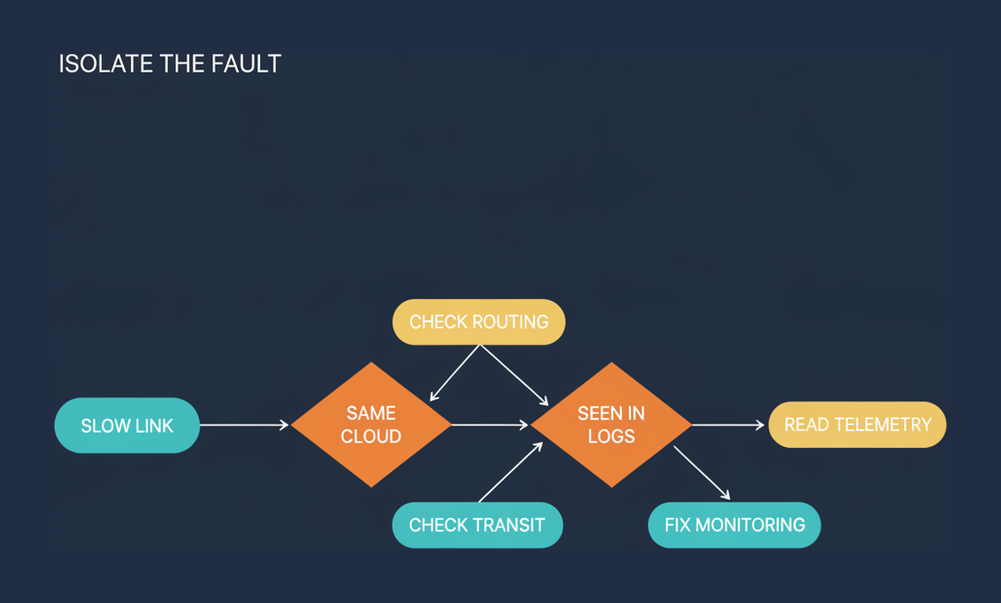
Faults cross boundaries no single team owns. A latency problem may originate in a provider’s transit path, a routing policy, an identity service, or a monitoring blind spot, and each of those belongs to a different group. The domain tests structured diagnosis under exactly that ambiguity: forming a hypothesis, isolating a layer, and knowing which evidence would disprove you.
What Does the Operations and Performance Domain Cover?
Network Operations, Monitoring, and Performance is the smallest CNX-001 domain at 16 percent, which still amounts to roughly 14 questions. It covers keeping a distributed design healthy once it is running, and it is where architecture meets the reality of who watches it at three in the morning.
Expect monitoring strategy across environments that do not share tooling, performance baselining when traffic crosses provider boundaries, and the operational consequences of design decisions made much earlier. Its modest weighting makes it a tempting domain to skim, which is precisely the risk that pass or fail scoring makes expensive.
What Experience Does CompTIA Expect You to Bring?
CompTIA recommends at least 10 years of IT experience for CNX-001, including 5 years in a network architect role, with hands on exposure to hybrid cloud environments. It also recommends foundational knowledge equivalent to Network+, Security+, and Cloud+.
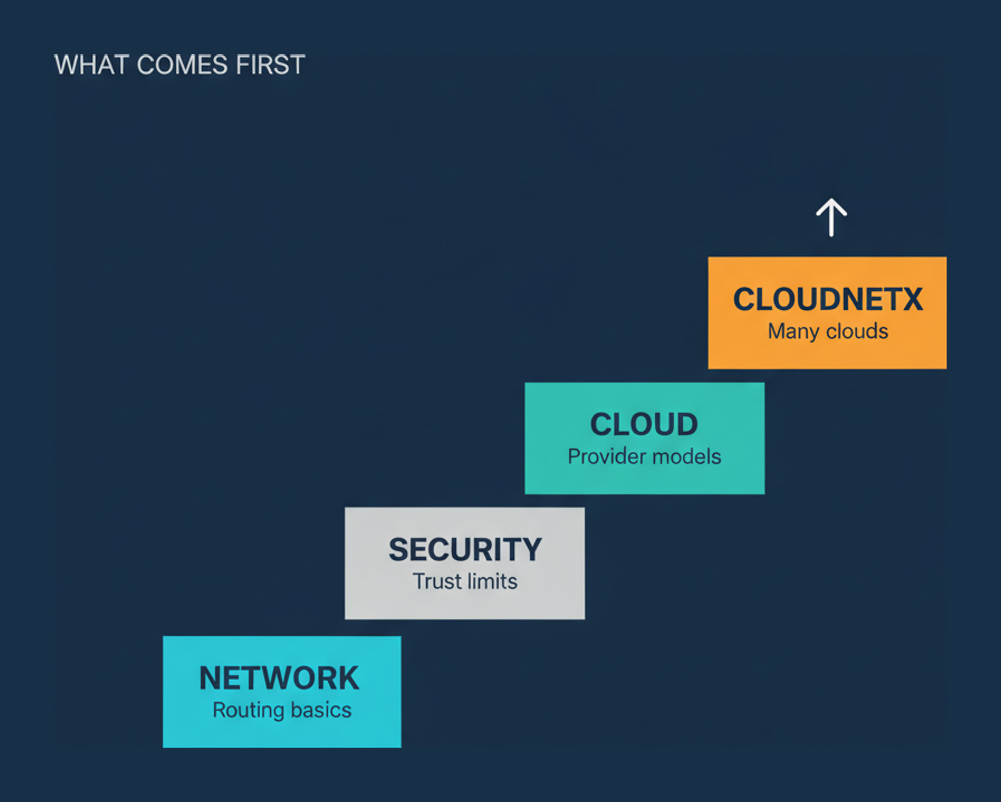
None of that is enforced at registration. It is a statement about the level the questions are written at, not a barrier. In practice the exam assumes you have already lived through a migration that did not go to plan, because the scenario questions are built from those situations. Candidates who have worked through the Cloud+ certification path will recognise the cloud fundamentals CloudNetX treats as assumed knowledge rather than teachable content.
Who Should Take CloudNetX?
CompTIA aims CloudNetX squarely at three roles, and the list is narrower than most of its certifications. This is a credential for people whose job is to decide how systems connect, not to keep them connected.
- Network architects designing across on premises and multiple cloud providers
- Security architects whose designs must hold at provider boundaries
- Enterprise architects accountable for how the whole estate fits together
If your work is implementation rather than design, the exam will feel misaimed, and a domain specific credential will serve you better. Salary expectations for the target roles are best judged from current network architect pay data rather than from certification marketing. The full objective list sits on the official CloudNetX page, background on the multi-cloud model is worth reading if the term is new to you, and testing is booked through Pearson VUE for CompTIA.
How Do You Prepare for a Pass or Fail Exam?
Pass or fail scoring changes preparation strategy more than most candidates expect. You cannot trade a weak domain against a strong one, because you will never see the arithmetic. Even coverage across all four CNX-001 domains is the only defensible plan.
A Sequence That Fits the Format
- Audit all four domains honestly. The flat weighting means your weakest area sets your risk.
- Refresh the fundamentals at design depth. Subnetting, CIDR, and BGP are assumed, not taught.
- Practise reading requirements. Every design objective begins with a business scenario.
- Rehearse structured diagnosis. Troubleshooting is a quarter of the paper and rewards method.
- Do not skim operations. Sixteen percent is still around 14 questions.
- Work at scenario length. At 165 minutes for 90 questions, pacing is comfortable but reading load is high.
Frequently Asked Questions About CloudNetX
How many questions are on the CNX-001 exam?
CloudNetX has 90 questions with a 165 minute limit, which allows roughly 110 seconds per question. That pacing is generous by design, because the scenario questions carry a heavy reading load.
What is the passing score for CloudNetX?
There is no passing score in the usual sense. CloudNetX is graded pass or fail only, with no scaled score reported, so you cannot see how close you came or which domain let you down.
How much does CloudNetX cost?
The exam price is USD $544, making it one of CompTIA’s more expensive certifications. Combined with pass or fail scoring, that cost is a strong argument for even preparation across all four domains.
Do I really need ten years of experience?
It is a recommendation, not an enforced prerequisite. CompTIA suggests at least 10 years in IT including 5 as a network architect, which describes the level the questions are pitched at rather than a registration barrier.
Which CloudNetX domain is the largest?
Network Architecture Design at 31 percent, followed by Network Security at 28 percent and Network Troubleshooting at 25 percent. Network Operations, Monitoring, and Performance is smallest at 16 percent.
Is CloudNetX harder than SecurityX?
They sit at the same expert tier and test different territory. SecurityX concentrates on security architecture and practice, while CloudNetX spans design, security, troubleshooting, and operations across hybrid and multi-cloud networks.
What foundational certifications does CompTIA recommend first?
CompTIA recommends foundational knowledge equivalent to Network+, Security+, and Cloud+. Holding those exact certifications is not required, but the exam assumes you already have the knowledge they cover.
How much routing knowledge does the exam expect?
Significant. OSPF and BGP are named explicitly alongside routing tables, and BGP in particular carries weight because it underpins interconnection between cloud providers in multi-cloud designs.
Is CloudNetX vendor neutral?
Yes. It is written to apply across multi-cloud environments rather than to one provider’s networking stack, which is what makes it useful for architects working across more than one platform.
When did CloudNetX launch?
The exam launched on 18 February 2025, which makes it one of CompTIA’s newest certifications. It was designed for hybrid cloud network architecture from the outset rather than adapted from an older networking credential.
Conclusion
CloudNetX is the most demanding thing CompTIA currently offers, and its structure says so plainly. Ninety scenario questions, four domains that no one can safely skip, a recommended decade of experience, and a result that arrives as a single word. The flat weighting and the pass or fail grading work together to remove every shortcut.
Prepare evenly, refresh the fundamentals at design depth rather than recall depth, and give troubleshooting the quarter of your attention the syllabus gives it. If you are already designing networks that cross providers, this credential describes what you do. If you are not yet, the foundational path is the better next step.