Somebody in the team is running the migration. They booked the vendor calls, built the schedule in a spreadsheet, chased the sign off, and told the business what would break and when. Their job title says systems administrator, or support lead, or developer. Nobody made them a project manager and nobody trained them to be one.
That person is exactly who the CompTIA Project+ certification was written for. PK0-005 is a vendor-neutral, entry-level credential aimed at IT professionals managing small to medium-sized projects, and CompTIA recommends the equivalent of six to twelve months of hands-on experience doing precisely that. It is 90 questions in 90 minutes, scored at 710 on a 100 to 900 scale, across four weighted domains that between them describe a whole project rather than a methodology. This guide covers all four, what the exam expects at each stage, and whether the credential is worth the fee for someone who already does the work.
Who Is CompTIA Project+ Actually For?
CompTIA Project+ is aimed at IT professionals who manage small to medium-sized projects without holding a project management job title. CompTIA recommends the equivalent of six to twelve months of hands-on experience managing projects in a technology environment, and describes the credential as teaching the entry-level skills needed to deliver those projects on time and within scope.
Two words in that description do a lot of work. Vendor-neutral means nothing on the exam is tied to a particular tool or platform, so the content survives a change of employer. Entry-level means the paper assumes you have been near a project, not that you have run a programme.
The audience it is not built for is equally clear. Someone whose full time job is project management, in an organisation with a project office and a defined methodology, will find the content familiar and the credential less useful than a professional-tier one. The value here is concentrated in the gap between doing the work informally and being recognised for it. CompTIA sets out the same positioning on its own Project+ certification page.
What Are the PK0-005 Exam Details?
PK0-005 runs 90 minutes with a maximum of 90 questions and a passing score of 710 on a scale of 100 to 900. Items are multiple-choice and performance-based rather than multiple choice alone. It is listed at 399 US dollars, booked through Pearson VUE, and offered in English, Japanese and Thai.
| Field | Value |
|---|---|
| Exam name | CompTIA Project+ |
| Exam series code | PK0-005 |
| Exam version | V5, launched 8 November 2022 |
| Questions | Maximum of 90 |
| Duration | 90 minutes |
| Passing score | 710 on a scale of 100-900 |
| Question types | Multiple-choice and performance-based |
| Listed price | $399 |
| Languages | English, Japanese, Thai |
| Delivery | Pearson VUE |
One minute per question sounds generous and is not, because performance-based items take longer than multiple choice ones. Those are the questions that put a scenario in front of you and ask you to do something with it rather than pick from four options, and they appear without warning.
Project+ is no longer a certification for life. CompTIA states that any Project+ certification earned on or after 1 October 2025 has to be renewed every three years through its Continuing Education programme to remain active, while one earned by 30 September 2025 stays valid for life. Older pages that still describe the credential as good for life are describing the earlier rule.
The 710 pass mark sits on a 100 to 900 scale rather than being a percentage, so the number of questions you can afford to lose varies with the form you sit. The four domains break down as follows.
| Domain | Weight |
|---|---|
| Project Management Concepts | 33% |
| Project Life Cycle Phases | 30% |
| Tools and Documentation | 19% |
| Basics of IT and Governance | 18% |
The first two domains together account for 63 percent of the paper, which tells you where the marks are. Working through PK0-005 practice material across all four is the fastest way to find out which of the smaller two is thin.
What Does Project Management Concepts Cover?
Project Management Concepts is the largest domain at 33 percent. It covers what makes something a project rather than ordinary work, the methodologies and frameworks used in IT delivery, the comparison between agile and waterfall thinking, and the change control process applied across the life cycle.
The methodology list is longer than most candidates expect and is named explicitly: DevSecOps, DevOps, Kanban, PRINCE2, the software development life cycle, Scrum, the Scaled Agile Framework, extreme programming and waterfall. The exam is not asking you to practise all nine. It is asking whether you can recognise which one an organisation is using and what that implies for how you plan.
Choosing between agile and waterfall
The comparison objective sets out real selection criteria: tolerance for change across requirements, budget and schedule; environmental factors including culture, development maturity and industry standards; team composition and product ownership; and differences in communication method. That is a decision framework rather than a definition, and it is where the domain gets examinable. For the Scrum side of it, the Scrum Guide is the short, authoritative reference and is worth reading in full because it takes under an hour.
Change control as a sequence
The change control objective is written as an ordered process: receive the request, log it, review it, assess impact, document a recommendation, identify the decision makers, escalate to a change control board where one exists, record the approval, communicate the status, update the plan, implement, validate and communicate the deployment. Learning it as a sequence rather than a concept is the right approach, because scenario questions test the order.
How Does the Exam Break a Project Into Phases?
Project Life Cycle Phases carries 30 percent and walks a project from discovery through to closing. The phases named are discovery and concept preparation, initiation, planning, execution, and closing, and the objectives ask what activities and artefacts belong to each rather than asking for definitions.
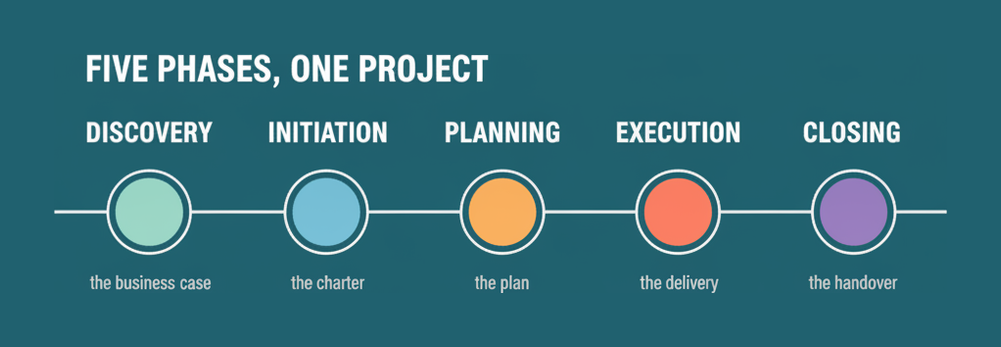
Discovery is the phase most people skip in practice and the exam does not. It covers the business case and return on investment analysis, current state against future state, prequalified vendors, predetermined clients, preexisting contracts including client statements of work and terms of reference, and the difference between capital and operational expenditure.
Initiation produces documents
Initiation covers developing the project charter with objectives, success criteria and a preliminary scope statement; identifying and assessing stakeholders; building a responsibility assignment matrix using RACI; establishing communication channels; developing a records management plan; defining access requirements; reviewing existing artefacts; determining solution design; and running the kickoff.
Planning is the densest phase
Planning covers the resource pool and procurement needs, assigning and training the team, the communication plan and meeting cadence, the detailed scope statement, units of work through a work breakdown structure or a backlog, the schedule, budget considerations, the quality assurance plan, an initial risk assessment, a transition and release plan covering operational training and handoff, and the project management plan with baselines, milestones and a minimally viable product.
Execution is where change management appears
Execution covers running tasks to the plan, implementing organisational change management including training, adoption and reinforcement, managing vendors and their rules of engagement, running project meetings, and tracking and reporting. Organisational change management sitting inside execution is a deliberate placement: the exam treats getting people to use the thing as part of delivering it.
Why Do Tools and Documentation Get Their Own Domain?
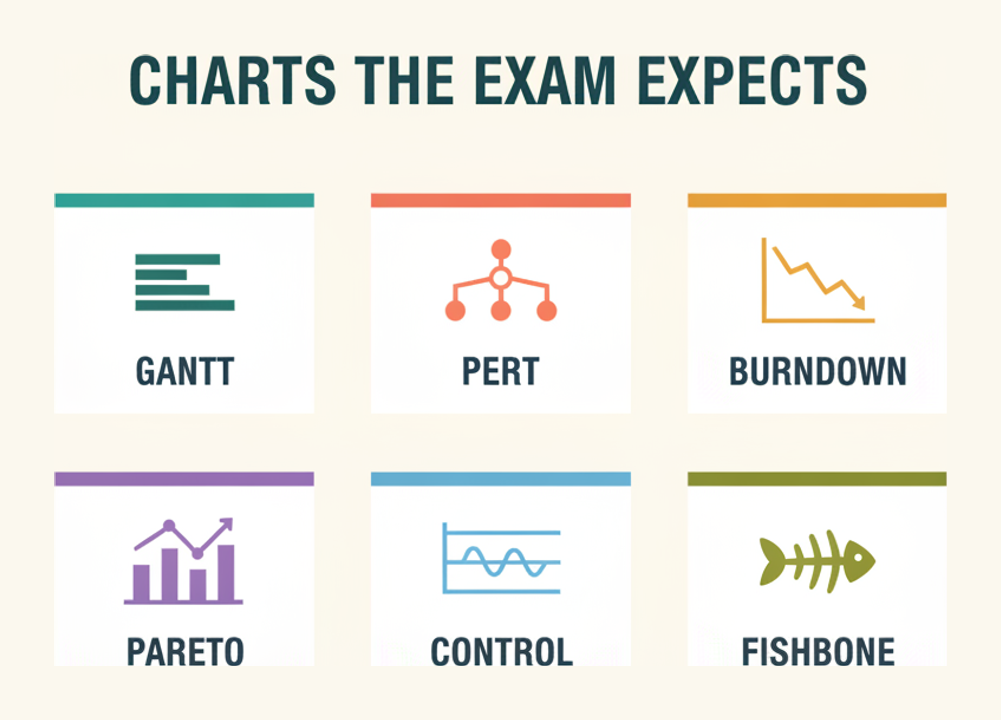
Tools and Documentation carries 19 percent of PK0-005 and covers the charts, logs, registers and platforms a project actually runs on. It names more individual items than any other domain, from Gantt and PERT charts through issue, defect and change logs to collaboration and conferencing platforms, and it ends with reading quality and performance charts to inform decisions.
The reason it stands alone is that these are the artefacts an entry-level project owner is judged on. A stakeholder rarely asks about your methodology. They ask for the status report, the risk register and the schedule, and the exam tests whether you know which artefact answers which question.
The final objective is the one that catches people. It asks you to analyse quality and performance charts: histograms, Pareto charts, run charts, scatter diagrams, fishbone diagrams, control charts, burnup and burndown charts, velocity charts and decision trees. That is nine chart types, several borrowed from quality management rather than project management, and recognising what each one is for is a fair exam question.
- Tracking charts covering Gantt, budget burndown, network diagram, milestone, PERT and organisational charts.
- Logs and registers covering issues, defects, changes, risk reports, risk registers, dashboards, status reports, version control, time tracking, task boards and requirements traceability.
- Productivity categories spanning communication, collaboration, meeting, documentation and scheduling tools, plus ticketing and case management.
What Is IT and Governance Doing on a Project Exam?
Basics of IT and Governance carries 18 percent and covers environmental, social and governance factors, information security concepts affecting project work, and the wider IT context a project runs inside. It is the domain that most clearly marks this out as an IT project credential rather than a general project management one.
The ESG objective covers a project’s impact on the local and global environment, awareness of applicable regulations and standards, awareness of company vision, mission and values, and the project’s effect on brand value. None of that is deep, and all of it is the kind of consideration an entry-level project owner is expected to raise rather than resolve.
The security objective is more concrete and splits four ways. Physical security covers mobile devices, removable media and facility access. Operational security covers background screening and clearance requirements. Digital security covers resource access and permissions, and remote access restrictions including multifactor authentication. Data security follows from those.
Read together, this domain answers a fair question about why an IT professional should sit an IT project exam rather than a generic one. The answer is that IT projects carry access, clearance and data handling considerations from the first planning meeting, and a credential that ignores them would not describe the job.
Is PK0-005 Different From PK0-004?
Yes. PK0-005 is version V5, launched on 8 November 2022, and it replaced PK0-004. The current exam is the only one CompTIA lists, and search demand still flowing to the older code is going to a retired paper. Anyone working from PK0-004 material is studying a superseded objective set.
This matters more than a version bump usually would, because the two smaller domains are where the change concentrates. The tools and documentation content reflects how projects are actually run now, with collaboration platforms, real-time multi-authoring, e-signature workflows and cloud scheduling tools named directly. The governance domain’s ESG content is a recent addition to project credentials generally.
The practical advice is simple. Check the code on any book, course or practice set before buying it, and treat anything that says PK0-004 as out of date rather than merely older. The CompTIAStudy PK0-005 study guide is written against the current objective set.
How Should You Prepare for the Project+ Exam?
Preparation works best by walking a real project through the objective list rather than reading the domains in order. Most candidates already have delivery experience, and mapping what they have done onto the exam’s vocabulary is faster than learning the vocabulary cold. The gaps that mapping exposes are then the study plan.
- Take a project you have actually run and write down what happened at each of the five life cycle phases, from discovery through initiation, planning and execution to closing.
- Compare that account against the objectives for each phase and mark every artefact the exam names that you did not produce, because those are your gaps rather than your weaknesses.
- Learn the nine methodologies and frameworks named in the first domain well enough to recognise which one an organisation is using and what it implies for planning.
- Memorise the change control process as an ordered sequence, since scenario questions test the order rather than the definition.
- Work through the tools domain by artefact, making sure you can say what each log, register, report and chart is for and which question it answers.
- Learn the nine quality and performance chart types by purpose, including the ones borrowed from quality management such as Pareto, fishbone and control charts.
- Cover the governance domain last, treating ESG as awareness level and the four security areas as concrete considerations that belong in a project plan.
- Sit timed practice at 90 questions in 90 minutes, allowing extra time for performance-based items so the pace is realistic rather than optimistic.
Working through the list in that order also keeps the smaller domains from being left until the night before, which is the most common way an otherwise well prepared candidate loses marks on this paper.
What the Credential Does for a Career
Project+ is most useful as evidence rather than as a qualification. It gives a hiring manager or an internal sponsor an independent read on whether someone who has been running projects informally actually knows the discipline, which is difficult to establish from a CV that lists a technical job title.
The realistic outcome is a change of remit rather than an immediate change of pay. Project coordinator and junior project manager roles frequently list a vendor-neutral project credential, and reported project coordinator salaries vary widely with sector and location rather than with certification alone. What the credential reliably does is make you eligible for postings that would otherwise filter you out.
There is a second, quieter benefit. Working through the objective list forces most people to notice which artefacts they have never produced, and the discovery phase content in particular tends to change how someone approaches the next project they are handed. That is worth something regardless of what the certificate does for a job application.
Frequently Asked Questions
How many questions are on the PK0-005 exam?
A maximum of 90, answered in 90 minutes. Items are multiple-choice and performance-based, and the performance-based ones take longer, so the pace is tighter than one minute per question suggests.
What is the passing score for CompTIA Project+?
710 on a scale of 100 to 900. It is a scaled score rather than a percentage, so no fixed number of correct answers guarantees a pass.
How much does CompTIA Project+ cost?
The exam is listed at 399 US dollars and is booked through Pearson VUE. Training and practice material are priced separately.
Is CompTIA Project+ worth it?
It is worth most to someone already running small projects without a project management title, because it turns informal experience into something a hiring manager can verify. A full time project manager in a mature project office will get less from it.
Does Project+ tie you to one methodology?
No. It is vendor-neutral and the first domain names nine methodologies and frameworks side by side, asking you to compare selection criteria rather than to practise any single one of them.
Which domain carries the most marks?
Project Management Concepts at 33 percent, followed by Project Life Cycle Phases at 30 percent. Together they account for 63 percent of the exam.
Do I need project management experience first?
CompTIA recommends the equivalent of six to twelve months of hands-on experience managing projects in a technology environment. It is not a formal prerequisite, but the exam is written for someone who has done the work.
Is PK0-004 still valid?
No. PK0-005 is the current V5 series code and replaced PK0-004. Study material carrying the older code is written against a superseded objective set.
What languages is Project+ available in?
Three: English, Japanese and Thai. That is a narrower set than several other CompTIA credentials offer.
Does the exam cover agile as well as waterfall?
Yes. The first domain names nine methodologies and frameworks including Scrum, Kanban, the Scaled Agile Framework, extreme programming, PRINCE2, DevOps, DevSecOps, the software development life cycle and waterfall, and asks you to compare agile and waterfall selection criteria.
Conclusion
The most useful way to read PK0-005 is as a description of a whole project rather than a syllabus. The concepts and the life cycle phases hold 63 percent of the marks, and the remaining 37 percent covers the artefacts you produce and the IT context you produce them in.
If you have already delivered something, most of the work is translation. Map a real project onto the five phases, mark the artefacts the objectives name that you never produced, and study those. Then rehearse at 90 questions in 90 minutes with room for the performance-based items, because that is where the pace pressure comes from. Practice questions against the current PK0-005 objectives are the fastest way to find out whether the translation worked, and the guidance on Project+ study planning covers how to structure those sessions when preparation time is short.