CompTIA AutoOps+ is not a DevOps engineer certification, and reading it as one is the fastest way to prepare for the wrong exam. It does not ask you to architect a platform, own a release train, or run a team. AT0-001 is aimed squarely at the systems, cloud and network administrator who already keeps infrastructure running by hand and now has to stop doing it by hand.
CompTIA launched it on 2 June 2026 as part of what it calls the Expansion Series, a set of credentials designed to sit on top of an existing core certification rather than replace one. The four domains say the same thing in different words: automation coding concepts, system configuration, continuous integration and continuous delivery. Not one of them is about designing a pipeline from nothing. All four are about automating work you are already responsible for. This guide covers what the AT0-001 exam actually asks, how the four domains are weighted, who CompTIA built it for, and where it fits against the certifications you probably already hold.
What Is CompTIA AutoOps+?
CompTIA AutoOps+ is a vendor-neutral automation certification with the exam code AT0-001, launched on 2 June 2026. It validates that an IT operations professional can automate configuration, provisioning and delivery work using scripting, infrastructure as code and continuous integration pipelines, across cloud, hybrid and on-premises environments.
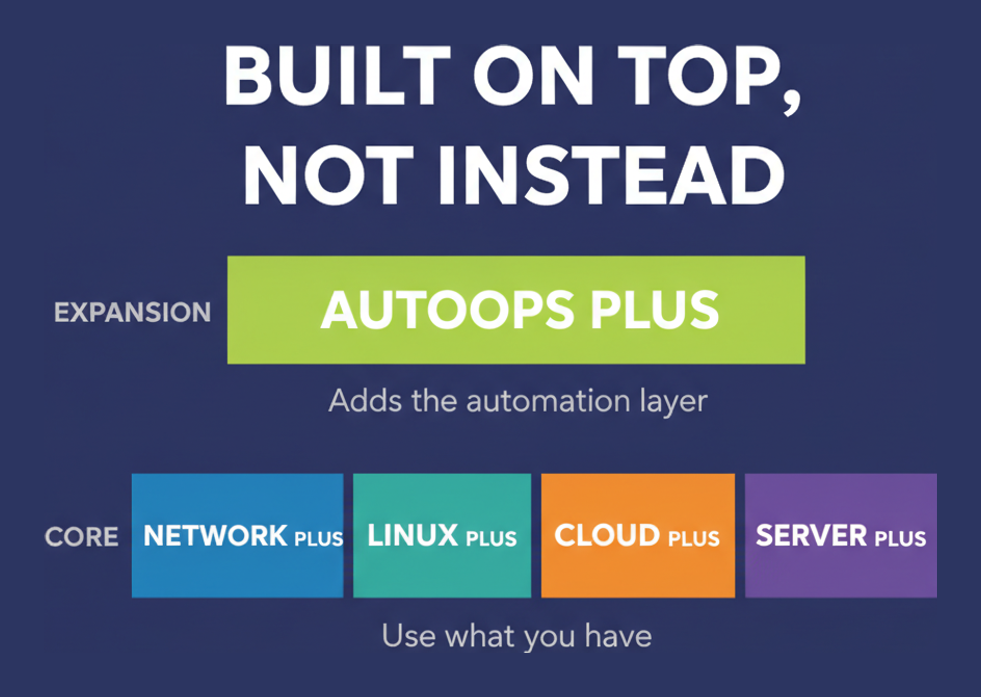
CompTIA positions it inside the Expansion Series, and that label carries meaning. Expansion certifications are built to add a specialism to a core credential rather than to stand alone. AutoOps+ assumes you already understand servers, networks or cloud infrastructure and adds the automation layer on top.
The full specification lives on CompTIA’s own AutoOps+ certification page, which also confirms the exam is currently at version one, and estimates that this version will retire roughly three years after launch. That estimate describes how long the version-one exam stays on sale, not how long a certification you have earned stays active.
What makes the credential unusual is its narrowness. Most automation learning paths are tied to a vendor: one for Ansible, one for Terraform, one for a particular cloud. AutoOps+ deliberately tests the concepts underneath all of them, which is why the objectives name generic ideas like idempotency and declarative configuration rather than product features. Teams running automation programmes usually pair technical skill with delivery discipline, covered in the PK0-005 certification guide.
How Are the Four AT0-001 Domains Weighted?
AT0-001 splits into four domains: Automation Coding Concepts at 31 percent, System Configuration at 25 percent, Continuous Integration at 24 percent, and Continuous Delivery at 20 percent. Coding is the largest single domain, which surprises administrators who expected an infrastructure paper.
| Domain | Weight | Approximate questions | Centre of gravity |
|---|---|---|---|
| Automation Coding Concepts | 31% | 19 | Code, source control and infrastructure as code |
| System Configuration | 25% | 15 | Provisioning and enforcing consistent state |
| Continuous Integration | 24% | 14 | Build, test and artifact pipelines |
| Continuous Delivery | 20% | 12 | Secure, compliant, repeatable deployment |
Question counts are derived from the weightings against a 60-item paper and are planning figures rather than a promise. What the distribution shows clearly is that Continuous Integration and Continuous Delivery together account for 44 percent. Nearly half the exam is pipeline work, and the other half is what feeds the pipeline.
Because the credential is new, the practical difficulty is not the concepts but the absence of a well-worn preparation path. Working through AutoOps+ exam questions is one of the few ways to calibrate against the real weighting before you sit it.
What Are the AT0-001 Exam Details?
AT0-001 is a maximum of 60 questions in 60 minutes, scored on a 100 to 900 scale with 600 as the pass mark, and delivered through Pearson VUE. The paper mixes multiple-choice items with performance-based items where you work inside a simulated tool rather than choosing an answer.
| Detail | Value |
|---|---|
| Certification name | CompTIA AutoOps+ |
| Exam code | AT0-001 |
| Version | V1 |
| Questions | Maximum of 60, multiple-choice and performance-based |
| Duration | 60 minutes |
| Passing score | 600 on a scale of 100 to 900 |
| Price | $298 USD |
| Language | English |
| Delivery | Pearson VUE |
Sixty items in sixty minutes is one minute each, and that budget has to absorb the performance-based questions as well. Those take several minutes apiece, which means the multiple-choice items have to be answered considerably faster than a minute to leave room. Time pressure, not difficulty, is the characteristic failure mode on a paper shaped like this.
Booking runs through Pearson VUE CompTIA exams in the usual way, with test-centre and online-proctored options. One planning note: CompTIA estimates that version one of the exam will retire around three years after its June 2026 launch. Keeping the certification active is a separate matter, because CompTIA lists AutoOps+ in its Continuing Education programme with a total fee of 75 US dollars for each three-year renewal period.
Who Is CompTIA AutoOps+ Designed For?
CompTIA recommends two to three years in a core IT operations role, naming network, cloud and systems administrators specifically, and suggests holding Network+, Linux+, Cloud+ or Server+ beforehand, or an equivalent credential. Those are recommendations rather than gates, but they describe the reader the objectives were written for.
Read that profile carefully and the exam’s shape makes sense. An administrator with three years of experience has already written the scripts, already fought the configuration drift, and already deployed something manually at ten o’clock at night. AutoOps+ asks them to name and formalise what they have been doing improvisationally.
Who it is not for
It is a poor fit for two groups. Developers who already live in Git and CI pipelines will find most of the coding domain familiar and the infrastructure framing unnecessary. And newcomers with no operations background will struggle, not because the concepts are hard, but because the questions assume you have seen the problems the automation solves.
The skills themselves are not niche. Containers, declarative configuration and pipeline-driven delivery have become the default way infrastructure is run, a shift the CNCF annual survey has tracked across the industry for years. What has been missing is a vendor-neutral way for an operations professional to evidence them.
What Coding Do You Need for Automation Coding Concepts?
Automation Coding Concepts is the largest domain at 31 percent, and it is broader than scripting. It covers reading and writing code that supports automation, versioning that code properly with Git, understanding infrastructure as code as a set of principles, and troubleshooting the code lifecycle when it breaks.
The language-level content is deliberately generic: variables and their scope, conditionals, iteration, parameters, functions, regular expressions, application logs and data types. Where it gets specific is in data formats and tooling. JSON and YAML are both named, and so are the command-line tools an administrator actually reaches for, including grep, awk, sed, jq and cmdlets.
Source control is examined properly
Git is not a passing mention. The objectives name remote commands (fetch, pull, push), local commands (add, commit, config), semantic versioning including pre-release versions, branching strategies for release and feature work, branch naming conventions, and the commit lifecycle with hooks, formatting, linting and detecting sensitive data before it lands.
That last item is worth dwelling on. Detecting sensitive data at commit time is a security objective hiding inside a source-control list, and it is the kind of thing an administrator who has only ever used Git as a backup will not have met.
Infrastructure as code is examined as concepts rather than syntax: reusability, immutability, declarative against imperative, and idempotency. Those four ideas explain most of why automation tools behave the way they do, and the exam expects you to reason with them rather than recite them. Dependency management appears here too, covering Dockerfiles, requirements files, packages and libraries.
What Do the Two Pipeline Domains Cover?
Continuous Integration at 24 percent and Continuous Delivery at 20 percent split the pipeline in two. Integration covers building and testing automatically so problems surface early and teams stay in step. Delivery covers getting a tested artifact into an environment reliably, securely and repeatably.
System Configuration, at 25 percent, sits between them and is often the domain candidates underestimate. It covers automating configuration, provisioning and maintenance with infrastructure as code and modern toolchains, and enforcing consistent state across environments. In practice it is the domain closest to the day job of a systems administrator.
The delivery domain carries an explicit security and compliance thread. CompTIA describes it as implementing secure, compliant delivery pipelines that enable rapid, reliable deployment, which places supply-chain thinking inside the exam rather than treating security as a separate subject.
Tooling fluency is assumed rather than tested by name, and that fluency is worth building against what the industry actually uses. The Stack Overflow developer survey is a reasonable guide to which pipeline and container tools you are most likely to meet in a real environment, which is a better basis for lab work than picking one at random.
How Should You Prepare for the AT0-001 Exam?
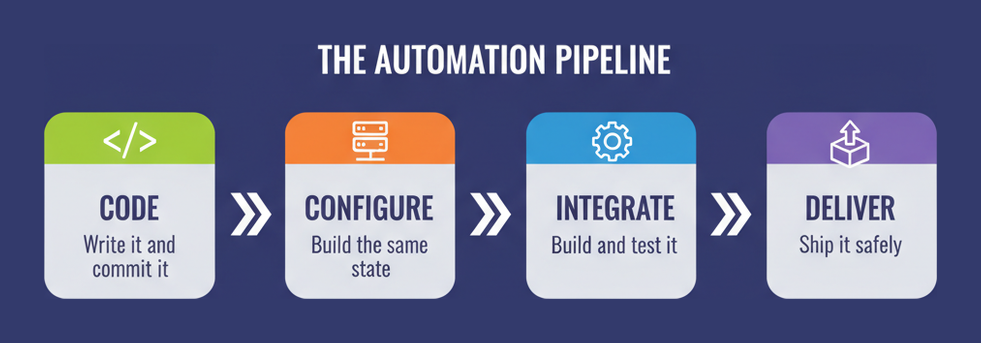
Preparation for AT0-001 works best when it follows the pipeline rather than the objective list, because the four domains describe one continuous flow. Code goes into source control, configuration turns it into infrastructure, integration builds and tests it, and delivery ships it. Studying them in that order means each domain arrives with a reason to exist.
- Start with Git, working in a real repository until branching, semantic versioning and the commit lifecycle including hooks and linting are habit rather than lookup.
- Move to data formats and command-line tooling next, writing YAML and JSON by hand and parsing real output with grep, awk, sed and jq until the syntax stops slowing you down.
- Build one small piece of infrastructure as code and rerun it deliberately, so idempotency and immutability become things you have watched happen rather than definitions you have read.
- Wire that same code into a continuous integration pipeline with automated tests and an artifact step, then break it on purpose and troubleshoot the failure end to end.
- Finish with delivery, adding a deployment stage with a rollback path and a secrets check, then rehearse under a clock because 60 items in 60 minutes leaves no recovery time.
Because AutoOps+ builds on an existing core credential, the fastest way to find your gaps is to compare it against what you already hold. Anyone coming from the systems side will find our Server+ exam objectives a useful baseline for what CompTIA assumes you already know before the automation layer starts.
The step candidates skip is the fourth one. Building a pipeline that works teaches less than breaking one and fixing it, and the troubleshooting objectives in the coding domain are written for exactly that experience.
Where Does AutoOps+ Sit in the CompTIA Stack?
AutoOps+ is an expansion credential, not a rung on the core ladder. It does not replace Network+, Linux+, Cloud+ or Server+, and it does not lead to them. It attaches to whichever of them you already hold and adds automation as a specialism, which is a different shape from CompTIA’s traditional progression.
That has a practical consequence for sequencing. If you hold none of the recommended core certifications, AutoOps+ on its own is a thin signal: it says you can automate, without establishing what you are automating. Paired with a core credential it reads much more strongly, because together they describe both the domain and the method.
Linux is the most natural pairing for this particular expansion, since almost every automation toolchain assumes a Linux host somewhere in the stack, and the command-line tools named in the coding domain are Linux tools. Candidates without that grounding will find our Linux+ certification guide the more useful place to start.
CompTIA sets out its own view of where the credential fits and why it created it on the AutoOps+ announcement post. The argument it makes is that automation has stopped being a specialist job title and become an expectation of ordinary operations work, which is a fair description of what the objectives test.
Frequently Asked Questions
What is the CompTIA AutoOps+ exam code?
AT0-001, currently at version one. CompTIA launched the credential on 2 June 2026 as part of its Expansion Series, which sits alongside the core certification track rather than inside it.
How many questions are on the AutoOps+ exam?
A maximum of 60, mixing multiple-choice items with performance-based items where you work inside a simulated environment. The time limit is 60 minutes, so the performance-based items have to be budgeted for carefully.
What is the passing score for AT0-001?
Six hundred on a scale of 100 to 900. That is a scaled score rather than a raw percentage, so it does not translate directly into a number of correct answers.
Which AutoOps+ domain carries the most marks?
Automation Coding Concepts, at 31 percent. System Configuration follows at 25 percent, Continuous Integration at 24 percent, and Continuous Delivery at 20 percent, so no domain can safely be skipped.
Do I need to know how to code for AutoOps+?
You need to read and reason about code rather than build applications. The objectives cover variables, conditionals, iteration, functions, regular expressions and data types, plus JSON, YAML and tools such as grep, awk, sed and jq.
Are there prerequisites for CompTIA AutoOps+?
No formal prerequisites. CompTIA recommends two to three years in a core IT operations role and suggests Network+, Linux+, Cloud+ or Server+, or a similar certification, as useful background.
Is AutoOps+ a DevOps certification?
Not exactly. It covers DevOps practices such as continuous integration and delivery, but it is aimed at operations professionals automating infrastructure work rather than at engineers owning a full software delivery platform.
Is Git covered on the AutoOps+ exam?
Yes, in depth. The objectives name remote and local Git commands, semantic versioning, branching strategies, branch naming conventions, and the commit lifecycle including hooks, linting and detecting sensitive data.
How long is CompTIA AutoOps+ valid?
CompTIA lists AutoOps+ in its Continuing Education programme, which renews certifications in three-year periods, with a total CE fee of 75 US dollars per period. Separately, it estimates that the version-one exam will retire about three years after its 2 June 2026 launch, which affects the exam on sale rather than a certification already held.
Which CompTIA certification should I take before AutoOps+?
Whichever core credential matches your day job. Linux+ is the most natural pairing because the command-line tools in the coding domain are Linux tools, but Server+, Cloud+ and Network+ are all named as suitable background.
Conclusion
CompTIA AutoOps+ takes the automation an experienced administrator already improvises and asks them to formalise it. Coding concepts carry 31 percent, the two pipeline domains carry 44 percent between them, and the whole paper is 60 items in 60 minutes with performance-based tasks folded in. It is a credential about method rather than about any one tool.
Work the four domains in pipeline order rather than objective order, build something small and then deliberately break it, and pair the credential with whichever core certification describes the infrastructure you actually run. Sitting it once the pipeline work has become habit is worth more than waiting until every objective feels perfectly prepared.