Five or more years in a data science role. That is what CompTIA recommends before you sit this exam, and it is not a number the vendor attaches to any of its better known credentials. Read it as the eligibility signal it is rather than as encouragement.
The CompTIA DataAI exam, code DY0-001, is CompTIA’s expert-level data science and machine learning credential, previously published under the name DataX. It runs to a maximum of 90 questions in 165 minutes, is scored pass or fail with no scaled score at all, and spreads its marks across five weighted domains that reach from linear algebra to computer vision.
Table of Contents
- What is the CompTIA DataAI exam?
- Why was CompTIA DataX renamed to DataAI?
- How are the five domains weighted?
- How is DY0-001 delivered and scored?
- The mathematics domain is real mathematics
- What does the machine learning domain expect?
- Is DataAI a step up from Data+?
- Who should attempt DY0-001, and when?
- Frequently Asked Questions
- Conclusion
What is the CompTIA DataAI exam?
The CompTIA DataAI exam, DY0-001, validates advanced data science and machine learning practice rather than data literacy. It covers mathematics and statistics, modelling and analysis, machine learning, the operational side of getting models into production, and specialised applications including natural language processing and computer vision. CompTIA positions it at expert level.
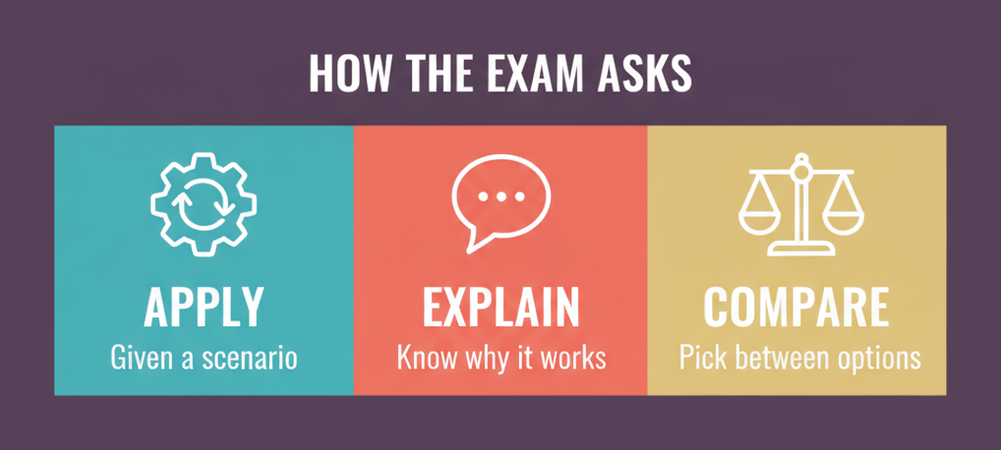
Twenty six objectives sit under the five domains, and the verbs used across them are telling. Thirteen begin with “given a scenario”, which in CompTIA’s grammar signals applied judgement rather than recall. The rest ask you to explain or to compare and contrast, and even those name specific techniques rather than general ideas.
The credential is vendor neutral, which for this subject matters more than usual. Nothing on the syllabus is tied to one cloud provider, one notebook environment, or one modelling library, so what it certifies is the reasoning rather than a toolchain. That also means nothing in the objectives can be revised by reading a single product’s documentation.
CompTIA estimates on its own certification page that this credential will retire around 2027, on the usual pattern of roughly three years after launch. That window matters for anyone weighing a long preparation runway against the value of holding the badge.
Why was CompTIA DataX renamed to DataAI?
The exam launched as CompTIA DataX and is now published as CompTIA DataAI, with CompTIA’s own certification page carrying the title “DataAI (formerly DataX)”. The exam code did not change, so DY0-001 refers to the same credential under both names, and study material written before the rename remains valid.
The practical consequence is a split in how people search for it. Search demand still sits almost entirely on the old name, and the new name barely registers yet. If you are hunting for objective breakdowns or study material, searching the old title will surface more results than the new one for some time.
The rename itself is not cosmetic. Read across the objectives and the machine learning content is the centre of gravity, deep learning has its own objective, and an entire domain is devoted to natural language processing and computer vision. DataX described what the exam covered in 2024. DataAI describes what it covers now.
One caution follows from this. Because the code is unchanged, pages that describe an older version of the objectives are indistinguishable at a glance from current ones. Check any breakdown you find against the published domain weights before planning around it, and the money site’s DY0-001 syllabus breakdown lists the objectives in full under their current headings.
How are the five domains weighted?
Modeling, Analysis and Outcomes and Machine Learning tie for the largest share at 24 percent each. Operations and Processes follows at 22 percent, Mathematics and Statistics at 17 percent, and Specialized Applications of Data Science is the smallest at 13 percent. No domain can be written off, and the two largest together account for just under half the paper.
| Domain | Weight | Approximate questions | What it is really about |
|---|---|---|---|
| Modeling, Analysis, and Outcomes | 24% | 22 | Exploratory analysis, data quality problems, enrichment, model design iteration, justifying a selection, communicating it |
| Machine Learning | 24% | 22 | Foundational concepts, statistical and tree-based supervised learning, unsupervised learning, deep learning |
| Operations and Processes | 22% | 20 | Data acquisition, ingestion and storage, wrangling, the life cycle, DevOps and MLOps, deployment environments, optimisation |
| Mathematics and Statistics | 17% | 15 | Statistical tests, probability and simulation, linear algebra and calculus, temporal and causal models |
| Specialized Applications of Data Science | 13% | 12 | Natural language processing, computer vision, other specialised applications |
Two observations are worth drawing out of that table before planning around it.
The first is that the practitioner half and the engineer half are almost evenly matched. Modelling plus machine learning plus the maths underneath them comes to 65 percent. Operations, deployment and MLOps come to 22 percent on their own. A pure modeller who has never shipped anything is exposed on a fifth of the paper.
The second is that 13 percent is not small in absolute terms. Specialized Applications is the lightest domain, but 13 percent of 90 questions is about twelve items, and they cover two genuinely separate fields. Skipping either natural language processing or computer vision costs more than the domain’s rank suggests.
How is DY0-001 delivered and scored?
DY0-001 runs to a maximum of 90 questions in 165 minutes at a cost of $544 USD, delivered through Pearson VUE. The question mix is multiple choice plus performance-based items, and the result is reported as pass or fail with no scaled score attached. That last detail is unusual for CompTIA and changes how you should read your own result.
| Field | Value |
|---|---|
| Credential name | CompTIA DataAI, formerly DataX |
| Exam code | DY0-001 |
| Level | Expert |
| Questions | Maximum of 90 |
| Question types | Multiple choice and performance based |
| Duration | 165 minutes |
| Passing score | Pass or fail, no scaled score |
| Price | $544 USD |
| Domains | 5, all weighted |
| Languages | English and Japanese |
| Recommended experience | 5 or more years in data science or a similar role |
| Expected retirement | Around 2027 |
What pass or fail with no scaled score means for you
Every other CompTIA exam most candidates have taken reports a number on a scale, which lets a near miss be read as a near miss. DY0-001 does not. A fail tells you nothing about how close you were, and there is no per-domain breakdown to plan a retake around.
The practical response is to build your own measurement before test day, because the exam will not supply one afterwards. Track practice performance by domain rather than overall, and treat any domain sitting materially below the others as the reason you would fail rather than as a rounding error.
Time is tighter than the headline suggests
Ninety questions in 165 minutes averages 110 seconds each, which sounds generous. Performance-based items do not obey that average: they involve working through a task rather than choosing between options, and a small number of them can absorb a large share of the clock. Budget accordingly and leave the longest items until you have banked the straightforward ones.
The mathematics domain is real mathematics
Seventeen percent of DY0-001 is Mathematics and Statistics, and the named sub-topics go well beyond descriptive statistics. Eigenvalues and eigenvectors, matrix decomposition, partial derivatives and the chain rule, the central limit theorem, Bayes rule, Monte Carlo simulation and bootstrapping all appear by name in the objectives.
The statistical testing content is equally specific. t-tests, chi-squared, analysis of variance, hypothesis testing and confidence intervals sit alongside a long list of performance metrics that the exam expects you to choose between rather than merely define.
- Regression metrics: R squared and adjusted R squared, root mean square error, the F statistic.
- Tree and split metrics: Gini index, entropy, information gain.
- Classifier metrics from the confusion matrix: accuracy, recall, precision, F1 and the Matthews correlation coefficient.
- Model comparison: the Akaike and Bayesian information criteria.
- Threshold behaviour: the ROC curve and AUC, which the syllabus names directly.
Two further objective groups in this domain are easy to overlook. Temporal models cover autoregressive, moving average and ARIMA specifications plus longitudinal studies and survival analysis, parametric and non-parametric. Causal inference covers directed acyclic graphs, difference-in-differences, A/B testing of treatment effects and randomised controlled trials.
Causal inference in particular is not something most working data scientists touch weekly, and it is the part of this domain where candidates most often discover they have been pattern matching rather than reasoning.
What does the machine learning domain expect?
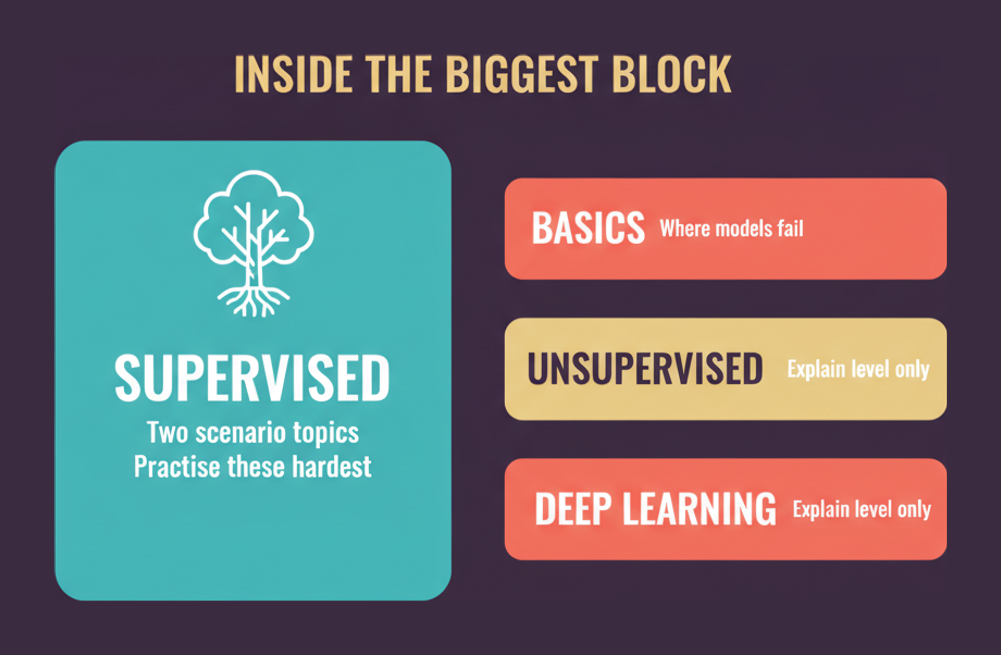
The machine learning domain is 24 percent of DY0-001 and splits into five objectives: foundational concepts, statistical supervised learning, tree-based supervised learning, unsupervised learning, and deep learning. Supervised learning gets two objectives to itself, which tells you where the weight inside the domain actually sits.
The foundational objective carries the failure modes
CompTIA’s own detail for this objective names loss functions, the bias-variance tradeoff, regularisation, cross-validation, ensemble models, hyperparameter tuning and data leakage. That is a list of the ways a model goes wrong rather than a list of algorithms, and it is consistent with an exam written for people who have shipped models and watched them degrade.
Data leakage deserves singling out. It is the failure that produces a beautiful validation score and a worthless production model, and it is the kind of thing an exam can only test through scenarios, which is exactly how this paper is built.
Deep learning and unsupervised learning are explain-level
Both deep learning and unsupervised learning are framed with “explain concepts related to” rather than “given a scenario, apply”. The distinction is deliberate and useful for planning: the exam wants you to understand what these families do and when they fit, not to tune an architecture under time pressure.
That makes them cheaper to prepare than their reputation suggests, and it is worth doing the arithmetic before allocating study time. Two explain-level objectives inside a 24 percent domain are a smaller investment than the same effort spent on the two supervised learning objectives, which are both scenario-based.
Is DataAI a step up from Data+?
No, and treating it as the next rung is the most common planning error around this credential. Data+ is an early career analytics credential with a scaled score and no experience recommendation. DataAI is an expert credential that CompTIA recommends five or more years of data science experience for, scored pass or fail, covering material Data+ does not approach.
The two exams answer different questions about a person. Data+ asks whether you can work with data responsibly and communicate what you find. DataAI asks whether you can choose, build, justify and operate a model.
| Comparison point | Data+ DA0-002 | DataAI DY0-001 |
|---|---|---|
| Positioning | Early career analytics | Expert data science |
| Recommended experience | None published | 5 or more years |
| Scoring | Scaled score | Pass or fail only |
| Machine learning | Not a domain of its own | 24 percent, five objectives |
| Mathematics depth | Descriptive and inferential statistics | Linear algebra, calculus, causal inference |
| Deployment content | Minimal | MLOps, environments, optimisation at 22 percent |
That does not make Data+ irrelevant preparation. The exploratory analysis, data quality and communication objectives in the DataAI modelling domain sit on foundations Data+ builds, and a reader who has recently worked through the Data+ domain breakdown will recognise part of that territory. The gap is the modelling, the mathematics and the operations, which is most of the paper.
There is a second CompTIA credential worth knowing about here, because the AI-era additions to the catalogue are easy to confuse. The SecAI security credential covers securing AI systems rather than building them, so the two sit beside each other rather than on one ladder.
Who should attempt DY0-001, and when?
Attempt DY0-001 when you have built and deployed models in a working environment, not when you have finished a course. CompTIA’s five-year recommendation is a description of the candidate the questions were written for, and the pass or fail scoring removes the usual comfort of a near miss. The readiness check below is worth working through honestly before booking.
- Confirm you have genuinely selected between competing models and justified the choice to somebody who disagreed, because an entire objective is written around exactly that.
- Test your statistics rather than your recall of it, choosing the right test for three scenarios you have not seen before and defending the choice.
- Work through the linear algebra and calculus vocabulary until eigenvectors, matrix decomposition and the chain rule are familiar rather than alarming.
- Study the supervised learning objectives hardest, since both are scenario-based and together they carry most of the heaviest domain.
- Read the deep learning and unsupervised objectives at explain level only, because that is the level the syllabus sets and time spent beyond it is time taken from elsewhere.
- Close the operations gap deliberately if you are a modeller, covering ingestion, storage, wrangling, MLOps and deployment environments, which together are 22 percent.
- Give natural language processing and computer vision real study time even though the domain is the smallest, since twelve questions across two fields is not a rounding error.
- Rehearse performance-based items under a clock, because they consume time at a different rate from multiple choice and the 165 minutes is less generous than it looks.
- Track your practice results by domain, since the exam itself will never give you that breakdown.
On the career side, the role this credential describes is a working data scientist rather than an analyst, and current data scientist pay data is a reasonable reference point for whether the five-year investment the exam assumes matches where you are heading.
Frequently Asked Questions
How many questions are on the CompTIA DataAI exam?
A maximum of 90 questions in 165 minutes. The mix includes performance-based items alongside multiple choice, so the real pace is less even than the 110 second average implies.
What is the passing score for DY0-001?
There is no passing score in the usual sense. CompTIA reports DY0-001 as pass or fail only, with no scaled score, which also means no per-domain breakdown to plan a retake around.
Is CompTIA DataAI the same exam as CompTIA DataX?
Yes. DataX was renamed to DataAI and the exam code DY0-001 did not change. CompTIA’s own certification page carries both names, and material published under the old title still refers to this credential.
How much does DY0-001 cost?
$544 USD. That is the highest price in CompTIA’s catalogue, which is consistent with its expert positioning rather than with the length of the exam.
Do you need five years of experience to take DataAI?
It is a recommendation rather than a gate, so nothing stops you booking earlier. CompTIA publishes it because the questions assume that background, and the scenario-heavy format is hard to answer from study alone.
Which DataAI domain is the largest?
Two tie at 24 percent: Modeling, Analysis and Outcomes, and Machine Learning. Operations and Processes follows at 22 percent, Mathematics and Statistics at 17, and Specialized Applications at 13.
How much mathematics does DY0-001 actually require?
More than most candidates expect. The syllabus names eigenvalues, matrix decomposition, partial derivatives, the chain rule, Bayes rule and the central limit theorem directly, alongside a full set of statistical tests and model metrics.
What languages is the DataAI exam offered in?
English and Japanese only. That is a narrow set even by CompTIA standards and is worth confirming before booking if you would prefer another language.
Is DataAI harder than Data+?
They are not on the same ladder. Data+ is an early career analytics credential with a scaled score; DataAI is an expert credential with a five-year experience recommendation, a machine learning domain worth 24 percent, and mathematics Data+ never touches.
When will DY0-001 retire?
CompTIA states that retirement usually falls about three years after launch and estimates 2027 for this credential. Anyone planning a long preparation runway should weigh that window before committing.
Conclusion
DY0-001 is the credential CompTIA wrote for people who already do the job. The five-year recommendation, the pass or fail result with no scaled score, and a syllabus running from matrix decomposition to computer vision all point the same way: this is a validation of existing practice rather than a qualification you study your way into from a standing start.
If you already select and defend models, and your weakness is the operations half or the mathematics underneath, the exam is a fair test and the preparation is tractable. If neither of those describes your week yet, the honest move is to build the experience first and keep the fee.
Working through the published objectives domain by domain is the quickest way to find out which of those two readers you are, and the weightings tell you where that work will pay back.