
The CompTIA Cybersecurity Analyst (CySA+) certification, identified by its CS0-003 exam code, is a cornerstone credential for professionals aiming to solidify their expertise in cybersecurity analysis. This vendor-neutral certification, offered by CompTIA, validates the critical skills necessary to prevent, detect, and combat cybersecurity threats effectively. Designed for those with foundational security knowledge, the CySA+ certification prepares individuals for roles such as security analyst, incident response analyst, and vulnerability management analyst by covering practical, hands-on cybersecurity analytics. This comprehensive article delves into the indispensable value of CySA+, its exam structure, core domains, and strategic preparation insights, helping you understand why this credential is essential for a resilient cybersecurity career.
Understanding the CompTIA Cybersecurity Analyst (CySA+) Credential
The CompTIA CySA+ certification serves as a pivotal benchmark for IT professionals transitioning into or specializing within the cybersecurity domain. It signifies a candidate’s ability to apply behavioral analytics to networks and devices, thereby improving the overall state of IT security. Unlike certifications that focus solely on offensive security, CySA+ emphasizes defensive skills, enabling certified individuals to proactively identify vulnerabilities and respond to security incidents. This focus on threat detection and response makes it invaluable in today’s rapidly evolving threat landscape. Holding this credential demonstrates a deep understanding of incident response, vulnerability management, security operations, and reporting, all critical components for a robust security posture within any organization.
Defining the CySA+ Role and its Core Mission
The primary mission of a CySA+ certified professional is to analyze and interpret security data, detect anomalies, and recommend and implement solutions to protect organizational assets. This often involves working with various security tools and technologies to perform real-time threat analysis. The certification positions individuals to defend against sophisticated persistent threats (APTs) and malware by leveraging threat intelligence and proactive security measures. It is particularly suited for individuals who are actively involved in the day-to-day operations of a security operations center (SOC) or a cybersecurity team. Analysts who spend most of their day writing playbooks rather than reading alerts may find the AutoOps+ automation exam the closer fit.
Why CySA+ is a Strategic Choice for Modern Professionals
In an era where cyberattacks are increasing in frequency and sophistication, organizations desperately need professionals who can perform in-depth threat analysis and incident handling. The CySA+ certification addresses this demand by providing a structured validation of these skills. It assures employers that a candidate possesses the practical abilities to secure and protect critical information infrastructure, making it a strategic choice for career advancement. Investing in CySA+ demonstrates a forward-thinking approach to professional development, aligning individual capabilities with industry needs and ensuring relevance in a competitive job market.
Examining the CS0-003 Structure
The CompTIA CySA+ (CS0-003) exam is designed to thoroughly test a candidate’s analytical and practical cybersecurity skills. Understanding its structure is the first step towards successful preparation, providing insight into the scope and depth of knowledge required. This assessment focuses on performance-based questions in addition to multiple-choice, demanding real-world problem-solving abilities rather than mere theoretical recall.
The key details for the CS0-003 exam include:
- Exam Name: CompTIA Cybersecurity Analyst (CySA+)
- Exam Code: CS0-003
- Exam Price: $439 (USD)
- Duration: 165 minutes
- Number of Questions: Maximum of 85
- Passing Score: 750 (on a scale of 100-900)
This structure necessitates not only a strong grasp of the technical concepts but also effective time management to address all questions within the allotted duration. The passing score, while on a scaled system, indicates the need for comprehensive preparation across all domains.
Navigating the Question Formats
The CS0-003 exam incorporates various question types to comprehensively assess a candidate’s proficiency. Candidates will encounter traditional multiple-choice questions, which test fundamental knowledge across the syllabus. However, a significant portion of the exam consists of performance-based questions (PBQs), which require candidates to apply their skills in simulated environments. These PBQs are particularly crucial as they gauge practical abilities to configure, troubleshoot, and analyze security scenarios, mirroring real-world challenges faced by cybersecurity analysts. Mastery of these question formats is essential for achieving a successful outcome. For the AI-specific counterpart to this credential, see the CompTIA SecAI+ domains.
Importance of Time Management in CS0-003
With 85 questions to complete in 165 minutes, effective time management becomes a critical skill during the CS0-003 exam. This translates to roughly less than two minutes per question, highlighting the need for efficient problem-solving and quick decision-making. Candidates should practice under timed conditions to acclimate to the pace, ensuring they can allocate sufficient time to more complex performance-based questions without rushing through simpler ones. Strategic pacing helps prevent scenarios where valuable points are lost due to unfinished sections, emphasizing that speed and accuracy are equally important.
Exploring the Core Competencies: CySA+ Domains
The CompTIA CySA+ CS0-003 exam is structured around four key domains, each contributing a specific percentage to the overall score. These domains represent the essential areas of knowledge and skill that a cybersecurity analyst must possess to perform their duties effectively. A balanced understanding across all these areas is vital for success, as each domain addresses critical aspects of threat detection, analysis, and response.
The core domains and their respective weightages are:
- Security Operations – 33%: This domain focuses on the practical application of security tools and techniques for monitoring, detecting, and analyzing threats. It covers areas such as security information and event management (SIEM), intrusion detection/prevention systems (IDS/IPS), and security orchestration, automation, and response (SOAR) principles. Professionals need to understand how to interpret alerts, identify indicators of compromise (IoCs), and perform security assessments.
- Vulnerability Management – 30%: This domain addresses the processes and tools used to identify, prioritize, and remediate vulnerabilities within an organization’s systems and applications. It includes understanding vulnerability scanning techniques, penetration testing concepts, patch management, and security configuration baselines. The ability to assess the impact of vulnerabilities and recommend appropriate mitigations is paramount here.
- Incident Response and Management – 20%: This domain covers the systematic approach to handling security incidents, from identification and containment to eradication, recovery, and post-incident analysis. It involves understanding incident response frameworks, communication protocols, and forensic analysis techniques to determine the root cause of an incident and prevent recurrence.
- Reporting and Communication – 17%: This domain emphasizes the importance of clear, concise, and effective communication of security findings to various stakeholders, both technical and non-technical. It includes reporting on security posture, compliance, audit results, and incident details. The ability to translate complex technical information into actionable intelligence for decision-makers is a key skill.
Mastering these domains equips professionals with a comprehensive skillset to protect organizational assets from evolving cyber threats.
Deep Dive into Security Operations
The Security Operations domain is the largest section of the CySA+ exam, reflecting the importance of day-to-day threat monitoring and analysis. Professionals must be proficient in using various security tools to continuously scan networks, endpoints, and applications for suspicious activities. This includes configuring and maintaining security controls, responding to alerts generated by SIEM systems, and understanding network traffic analysis. A strong grasp of this domain enables analysts to move beyond reactive security to a more proactive stance, identifying potential threats before they escalate into full-blown incidents.
Addressing Vulnerabilities: The Management Perspective
Vulnerability Management is crucial for maintaining a strong security posture. This domain covers techniques for identifying weaknesses in systems, applications, and networks, alongside strategies for mitigating those risks. Candidates should understand how to conduct thorough vulnerability assessments, interpret the results from various scanning tools, and prioritize remediation efforts based on severity and potential impact. Knowledge of secure configuration management and continuous monitoring ensures that identified vulnerabilities are not only fixed but also prevented from recurring. This proactive stance significantly reduces an organization’s attack surface.
The Strategic Value of CySA+ Certification for Your Career
For cybersecurity professionals, the CySA+ certification is more than just another credential; it is a strategic investment that significantly enhances career prospects and earning potential. In a landscape increasingly besieged by sophisticated cyber threats, organizations are desperately seeking analysts who can not only identify vulnerabilities but also respond effectively to breaches. The practical, behavioral analytics approach of CySA+ directly addresses these critical needs, making certified individuals highly sought after. Achieving this certification often translates into better job opportunities, increased responsibilities, and a competitive edge in the job market, solidifying its worth for dedicated professionals.
Elevating Your CompTIA CySA+ Salary and Job Prospects
Earning the CySA+ certification can have a substantial impact on a professional’s earning potential. Salaries for cybersecurity roles, especially those requiring analytical and incident response skills, are consistently above average in the IT industry. Certified CySA+ professionals often command higher salaries due to their validated expertise in threat detection and incident management. Beyond salary, the certification opens doors to a wider array of specialized CySA+ certification jobs, including Security Analyst, Vulnerability Analyst, Threat Intelligence Analyst, and Incident Response Specialist. The demand for these roles continues to grow, ensuring a robust job market for those with this valuable credential.
Is CySA+ Worth It? A Career Trajectory Assessment
The question “is CySA+ worth it” can be answered by looking at the growing emphasis on proactive cybersecurity measures and the increasing complexity of threats. For individuals aiming to specialize in defensive security operations, incident response, or vulnerability management, CySA+ is unequivocally valuable. It bridges the gap between foundational certifications like Security+ and advanced certifications like PenTest+ or CASP+. Many organizations view CySA+ as a key indicator of a candidate’s readiness to perform critical security functions, providing a clear path for professional development and advancement within the cybersecurity field. For detailed insights into the certification’s benefits and recognition, visit the official CompTIA CySA+ page.
Navigating Effective CySA+ Certification Training
Effective preparation for the CySA+ certification exam requires a structured and comprehensive approach that goes beyond rote memorization. Given the exam’s emphasis on practical application and analytical skills, candidates must engage with a variety of study materials and training methods. A well-rounded CySA+ certification training strategy incorporates official resources, practical exercises, and consistent self-assessment to ensure thorough understanding of the CompTIA CySA+ exam objectives. This strategic preparation not only helps in passing the exam but also in building a solid foundation for real-world cybersecurity challenges.
Compiling a Robust CompTIA CySA+ Study Guide
A comprehensive CompTIA CySA+ study guide is essential for organizing your learning journey. This should include official CompTIA study materials, reputable third-party textbooks, and online courses that align with the CS0-003 exam objectives. Focus on understanding the underlying concepts rather than just memorizing facts, as the exam tests your ability to apply knowledge. Create a study schedule that allocates sufficient time to each domain, prioritizing areas where you may feel less confident. Integrating practical labs and simulations into your study guide can further solidify your understanding of complex security operations and incident response procedures.
Maximizing Your Practice with CompTIA Cybersecurity Analyst Practice Questions
Engaging with a diverse set of CompTIA Cybersecurity Analyst practice questions is crucial for gauging your readiness and identifying knowledge gaps. Look for practice tests that emulate the CS0-003 exam format, including performance-based questions. These simulations help you become comfortable with the testing environment and improve your time management skills. Analyzing both correct and incorrect answers, along with their explanations, provides valuable learning opportunities. For comprehensive practice questions and structured exam preparation, consider platforms like Edusum’s dedicated resources to enhance your readiness. Regular practice builds confidence and refines your problem-solving abilities.
Distinguishing CySA+ from Security+ Certification
While both CySA+ and Security+ certifications are offered by CompTIA and are crucial for a cybersecurity career, they serve distinct purposes and target different levels of expertise. Understanding the differences is vital for professionals planning their certification roadmap and ensuring they pursue the credential most aligned with their career aspirations and current skill set. Security+ provides a foundational understanding of core security concepts, while CySA+ delves deeper into the analytical and hands-on aspects of cybersecurity.
Security+ as the Foundational Cybersecurity Knowledge
The CompTIA Security+ certification is generally considered the industry-standard entry-level credential for cybersecurity. It covers fundamental principles of network security, compliance, threat management, and cryptography. Professionals pursuing Security+ typically aim to establish a broad understanding of security concepts that are applicable across various IT roles. It validates a baseline of security knowledge, preparing individuals for entry-level security positions or for further specialization. Many employers view Security+ as a prerequisite for any role involving security responsibilities, making it an excellent starting point for those new to the field or wanting to validate their foundational cybersecurity knowledge. Learn more about the CompTIA Security+ credential for a comprehensive understanding of its offerings.
CySA+ as the Behavioral Analytics and Incident Response Specialization
In contrast, CySA+ is an intermediate-level certification designed for professionals who have already mastered foundational security concepts, ideally demonstrated by a Security+ certification or equivalent experience. CySA+ shifts the focus to the practical application of cybersecurity analytics, threat detection, and incident response. It validates the ability to proactively capture, monitor, and respond to network traffic and data, identify vulnerabilities, and perform forensic analysis. This specialization is geared towards roles that require hands-on threat intelligence, vulnerability management, and active defense strategies, making it a natural progression for those looking to deepen their analytical capabilities in cybersecurity.
Renewing Your CySA+ Credential
Maintaining the relevance of your CySA+ certification is as important as earning it, especially in the fast-paced world of cybersecurity. CompTIA’s continuing education (CE) program ensures that certified professionals stay current with the latest industry trends, technologies, and threat landscapes. Understanding the CompTIA CySA+ renewal requirements is crucial for preventing your certification from expiring and for demonstrating ongoing commitment to professional development. The renewal process is designed to be flexible, accommodating various professional activities that contribute to continuous learning and skill enhancement.
Understanding CompTIA CySA+ Renewal Requirements
To renew the CompTIA CySA+ certification, professionals must earn 60 Continuing Education Units (CEUs) within a three-year cycle. These CEUs can be acquired through a variety of activities, including earning higher-level CompTIA certifications, attending industry events, publishing articles, teaching relevant courses, or completing various training programs. CompTIA provides detailed guidelines on eligible activities and their corresponding CEU values. It is imperative to track your CEU accumulation and submit them through your CompTIA certification account to ensure timely renewal. This commitment to ongoing education reinforces the value and credibility of your CySA+ credential.
Strategic Approaches to Earning Continuing Education Units
Earning the required 60 CEUs can be integrated into your regular professional development activities. Many cybersecurity professionals choose to pursue advanced certifications, such as CompTIA PenTest+ or CASP+, which automatically fulfill the CEU requirements for CySA+. Attending cybersecurity conferences, webinars, and workshops also provides valuable CEUs while keeping you informed about emerging threats and technologies. Participating in relevant industry-specific work activities, such as designing security solutions or performing vulnerability assessments, can also count towards renewal. Proactively planning your CEU activities ensures that you meet the renewal requirements without last-minute stress. For more information on activities that count towards CEUs, refer to comprehensive cybersecurity career resource documents.
Skills Validated by CySA+ for Real-World Application
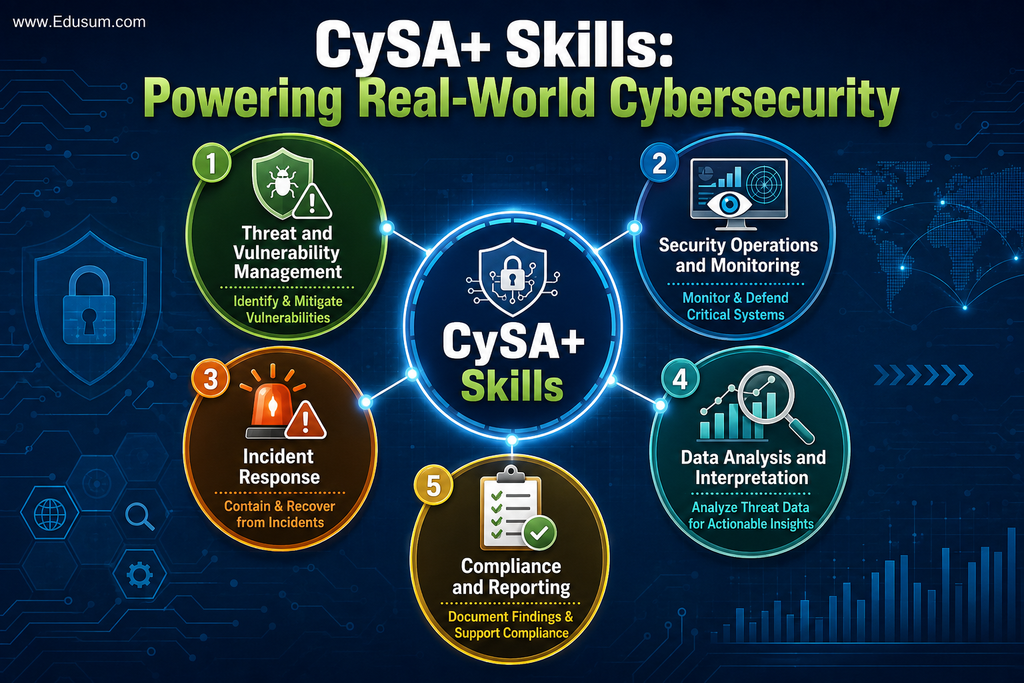
The CySA+ certification validates a practical and applied skillset directly relevant to the dynamic challenges faced by cybersecurity professionals today. Rather than focusing on theoretical knowledge alone, the exam measures a candidate’s ability to perform critical security tasks, analyze data, and implement solutions in real-world scenarios. These validated skills encompass a broad range of competencies, from proactive threat hunting to meticulous incident response, positioning CySA+ holders as invaluable assets to any security team. The certification ensures that professionals possess the necessary capabilities to defend against sophisticated cyber threats.
Mastering the Essential Skills for CySA+ Certification
The skills for CySA+ certification are deeply embedded in its core domains. Professionals must demonstrate proficiency in:
- Threat and Vulnerability Management: Identifying, assessing, and mitigating security weaknesses using various scanning tools and methodologies.
- Security Operations and Monitoring: Utilizing SIEM systems, IDS/IPS, and other security tools to monitor networks, detect anomalies, and interpret security events.
- Incident Response: Executing incident handling procedures, including containment, eradication, recovery, and post-incident analysis, following established frameworks.
- Data Analysis and Interpretation: Analyzing security logs, network traffic, and forensic data to identify indicators of compromise (IoCs) and attack patterns.
- Compliance and Reporting: Understanding security policies, compliance frameworks, and effectively communicating security posture and incident details to stakeholders.
These skills are foundational for performing the duties of a cybersecurity analyst, enabling them to make informed decisions and implement effective security controls.
Applying CompTIA CySA+ Domains in Practical Scenarios
The knowledge gained across CompTIA CySA+ domains translates directly into practical, day-to-day responsibilities. For instance, understanding Security Operations means you can actively monitor network traffic for suspicious activities, investigate alerts from a SIEM, and apply threat intelligence to detect emerging threats. In Vulnerability Management, you would conduct regular vulnerability scans, analyze the results, and work with development or operations teams to patch identified weaknesses. Incident Response and Management skills allow you to lead or assist in handling security breaches, ensuring rapid containment and recovery. Finally, strong Reporting and Communication skills enable you to present complex technical findings clearly to both technical and non-technical audiences, influencing security decisions within the organization. These applications underscore the real-world value of the CySA+ credential.
Advancing Your Cybersecurity Analyst Career Path
The CompTIA CySA+ certification serves as a critical stepping stone in the cybersecurity analyst career path, opening doors to more specialized and senior roles. It provides the intermediate-level validation that many organizations seek for roles involving hands-on security operations, vulnerability management, and incident response. Professionals who achieve CySA+ often find themselves better positioned for advancement, with a clearer trajectory towards leadership positions or highly specialized technical roles within the security domain. This certification empowers individuals to take on greater responsibilities and contribute more significantly to an organization’s security posture.
Transitioning to Senior Cybersecurity Roles
With CySA+ under your belt, the path to senior cybersecurity roles becomes more accessible. Positions such as Senior Security Analyst, SOC Lead, or even a specialized role like Threat Hunter often require the kind of analytical and practical skills validated by CySA+. The certification demonstrates a capability to not only react to threats but also to proactively seek them out and develop robust defense mechanisms. This proficiency is highly valued, distinguishing candidates who can drive security initiatives rather than simply follow them, thus paving the way for substantial career growth and influence within the organization.
Exploring Advanced Specializations After CySA+
After mastering the core competencies validated by CySA+, professionals can further refine their expertise by pursuing advanced specializations. This might involve diving deeper into ethical hacking with certifications like CompTIA PenTest+, focusing on cloud security with a cloud-specific credential, or ascending to leadership with certifications like CompTIA CASP+. The CySA+ acts as a strong foundation, making it easier to absorb more complex topics and integrate advanced skills into your existing knowledge base. This strategic progression ensures continuous learning and adaptation to new technologies and threats, making your career future-proof.
Overcoming Challenges in CySA+ Exam Preparation
Preparing for the CompTIA CySA+ exam, particularly the CS0-003 version, can present its own set of challenges, from the breadth of the syllabus to the complexity of performance-based questions. Successfully navigating these hurdles requires more than just studying; it demands strategic planning, persistent effort, and a commitment to ethical preparation. Understanding common pitfalls and adopting effective study habits will significantly enhance your chances of success and ensure a solid foundation in cybersecurity analytics. This focused approach to CS0-003 exam prep is vital for anyone serious about earning the credential.
Common Pitfalls in CySA+ Exam Preparation
One of the most frequent challenges candidates face in CySA+ exam preparation is underestimating the practical nature of the exam. Merely memorizing concepts without understanding their application can lead to difficulties with performance-based questions. Another pitfall is neglecting specific domains, assuming a strong grasp of others will compensate. The exam requires a balanced understanding across all areas. Furthermore, relying on illicit “exam dumps” is not only unethical but also counterproductive, as these materials do not foster genuine understanding and often contain outdated or incorrect information, leading to certain failure. Ethical study practices are paramount for long-term success.
Strategies for Effective CS0-003 Exam Prep
To overcome these challenges, adopt a multi-faceted approach to your CS0-003 exam prep. Start by thoroughly reviewing the official CompTIA CySA+ exam objectives to understand the scope of the material. Utilize a variety of learning resources, including official study guides, video courses, and hands-on labs, to gain both theoretical knowledge and practical experience. Dedicate ample time to practicing performance-based questions to familiarize yourself with their format and problem-solving requirements. Join study groups or online forums to discuss concepts and clarify doubts. Most importantly, maintain an ethical stance, focusing on genuine learning and skill development, which will ultimately serve you better in your career than any shortcuts.
The CompTIA CySA+ certification is undeniably a non-negotiable credential for cybersecurity professionals determined to future-proof their careers. It equips individuals with the analytical prowess and practical skills essential for navigating the complex threat landscape, from proactive vulnerability management to swift incident response. By validating critical capabilities in security operations and data analysis, CySA+ positions its holders as vital defenders of organizational assets. This certification not only enhances job prospects and earning potential but also fosters a commitment to continuous learning, ensuring professionals remain at the forefront of cybersecurity innovation.
Embarking on your CySA+ journey today is a strategic move toward a resilient and impactful career in cybersecurity. Leverage comprehensive study materials, engage with practical exercises, and commit to a structured preparation plan that aligns with the exam objectives. Continuous learning and ethical preparation are the cornerstones of not just passing the exam, but truly mastering the skills that safeguard digital infrastructures. Further enhance your advanced penetration testing skills by exploring the CompTIA PenTest+ certification guide, a valuable next step in your professional development.
Frequently Asked Questions
1. What is the primary focus of the CompTIA CySA+ (CS0-003) certification?
The CompTIA CySA+ (CS0-003) certification primarily focuses on validating the skills required for cybersecurity analysts to prevent, detect, and respond to cybersecurity threats through behavioral analytics and security operations.
2. Is prior experience recommended before attempting the CySA+ exam?
Yes, CompTIA recommends candidates have at least four years of hands-on experience in a cybersecurity role, or hold a CompTIA Security+ certification along with equivalent experience, before attempting the CySA+ exam.
3. How does CySA+ differ from CompTIA Security+?
CompTIA Security+ provides a foundational understanding of core security concepts, while CySA+ is an intermediate-level certification that focuses on the practical application of cybersecurity analytics, threat detection, and incident response, building upon foundational knowledge.
4. What types of job roles typically benefit from CySA+ certification?
Job roles that significantly benefit from CySA+ certification include Security Analyst, SOC Analyst, Vulnerability Management Analyst, Threat Intelligence Analyst, Incident Response Specialist, and Cybersecurity Specialist.
5. What is the renewal process for the CompTIA CySA+ certification?
To renew the CompTIA CySA+ certification, professionals must earn 60 Continuing Education Units (CEUs) within a three-year cycle through various approved activities such as earning higher certifications, attending events, or completing training.